Question
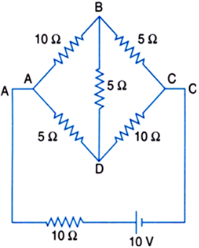
Determine the current in each branch of the network shown in Fig.:
Answer

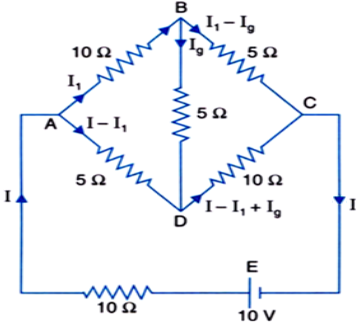
Consider the mesh ABDA, Now, Applying Kirchhoff's loop rule we get, $-10\text{I}_1-5\text{I}_\text{g}+(\text{I}-\text{I}_1)5=0$ $\Rightarrow\ \ 3\text{I}_1-\text{I}+\text{I}_\text{g}=0\ \ ...\text{(i)}$

Consider the mesh BDCB, Again, applying Kirchhoff's loop rule we get,
$-5\text{I}_\text{g}-10(1-\text{I}_\text{l}+\text{I}_\text{g})+5(\text{I}_\text{I}-\text{I}_\text{g})=0$
$\Rightarrow\ \ 3\text{I}_1-2\text{I}-4\text{I}_\text{g}=0\ \ ...\text{(ii)}$
Applying Kirchhoff's loop rule to the mesh ABCEA, $-10\text{I}_1-5(\text{I}_1-\text{I}_\text{g})-10\text{I}+10=0$ $\text{or}\ \ 3\text{I}_1+2\text{I}-\text{I}_\text{g}=2\ \ ...{(\text{iii})}$ Equations (i), (ii) and (iii) are simultaneous equations.
On solving these equations, we will find the unknown values of current.
Adding (i) and (iii), we get $6\text{I}_\text{1}+\text{I}=2\ \ ...(\text{iv})$
Multiplying (i) by 4 and adding in (ii),
we get $15\text{I}_\text{1}-6\text{I}0=0\ \ ...\text{(v)}$
Solving equations (iv) and (v), we get $\text{I}_1=\frac{4}{17}\text{A}=0.235\ \text{A}$
So, current in branch AB is 0.235 A. Putting the value of $I_1$ in equation (v) and simplifying,
we get Total current, $\text{I}=\frac{10}{17}=0.588\ \text{A}$
Putting the values of I and $I_1$ in equation (iii) and simplifying,
we get $\text{I}_\text{g}=\frac{2}{17}\text{A}=-0.118\ \text{A}$
The negative sign indicates that the direction of current is opposite to that shown in Fig.
above. So, current in branch BD is -0.118 A.
Current in branch BC is $(\text{I}_1-\text{I}_\text{g})\text{i.e}.,\frac{4}{17}-\Big(-\frac{2}{17}\Big)$
$\text{i.e.,}\frac{6}{17}\ \text{or}\ 0.353\ \text{A}.$ Current in branch AD is $(I - I_1)$
$\text{i.e.,}\Big(\frac{10}{17}-\frac{4}{17}\Big)\text{A i.e.,}\ \frac{6}{17}\text{A or}\ 0.353\ \text{A}$
Current in branch DC is $ (I_1 - I_1 + I_g)$
$\text{i.e.,}\frac{6}{17}+\Big(-\frac{2}{17}\Big)​​\text{A or}\ \frac{4}{17}\text{A or}\ 0.235\ \text{A}.$

Need a full question paper?

Generate a complete, print-ready paper with questions like this in minutes — across 16+ boards, with answer keys.
Start Generating Free

Similar questions

The temperature and pressure at Simla are 15.0°C and 72.0cm of mercury and at Kalka these are 35.0°C and 76.0cm of mercury. Find the ratio of air density at Kalka to the air density at Simla.
A narrow beam of singly charged potassium ions of kinetic energy 32keV is injected into a region of width 1.00cm with a magnetic field of strength 0.500T, as shown in the figure. The ions are collected at a screen 95.5cm away from the field region. If the beam contains isotopes of atomic weights 39 and 41, find the separation between the points where these isotopes strike the screen. Take the mass of a potassium ion $= A (1.6 \times 10^{-27})kg$, where A is the mass number.
The flux of magnetic field through a closed conducting loop changes with time according to the equation, $\phi=\text{at}^2+\text{bt}+\text{c}.$
  1. Write the SI units of a, band c.
  2. If the magnitudes of a, b and c are 0.20, 0.40 and 0.60 respectively, find the induced emf at t = 2s.
$a.$ Show that an ideal inductor does not dissipate power in an ac circuit.
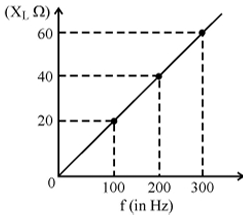
$b.$ The variation of inductive reactance $\left( X _{ L }\right)$ of an inductor with the frequency $( f )$ of the $ac$ source of $100 V$ and variable frequency is shown in the fig.
Image

$i.$ Calculate the self$-$inductance of the inductor.
$ii.$ When this inductor is used in series with a capacitor of unknown value and a resistor of $10 \Omega$ at $300 s^{-1}$, maximum power dissipation occurs in the circuit. Calculate the capacitance of the capacitor.
Deuteron is a bound state of a neutron and a proton with a binding energy B = 2.2MeV. A γ-ray of energy E is aimed at a deuteron nucleus to try to break it into a (neutron + proton) such that the n and p move in the direction of the incident γ-ray. If E = B, show that this cannot happen. Hence calculate how much bigger than B must E be for such a process to happen.
A box weighing 2000N is to be slowly slid through 20m on a straight track having friction coefficient 0.2 with the box.
  1. Find the work done by the person pulling the box with a chain at an angle $\theta $ with the horizontal.
  2. Find the work when the person has chosen a value of $\theta $ which ensures him the minimum magnitude of the force.
When a Coolidge tube is operated for some time it becomes hot. Where does the heat come from?
At what angle should a ray of light be incident on the face of a prism of refracting angle 60° so that it just suffers total internal reflection at the other face? The refractive index of the material of the prism is 1.524.
Two concave mirrors of equal radii of curvature R are fixed on a stand facing opposite directions. The whole system has a mass m and is kept on a frictionless horizontal table. Two blocks A and B, each of mass m, are placed on the two sides of the stand. At t = 0, the separation between A and the mirrors is 2 R and also the separation between B and the mirrors is 2 R. The block B moves towards the mirror at a speed v. All collisions which take place are elastic. Taking the original position of the mirrors-stand system to be x = 0 and X-axis along AB, find the position of the images of A and B at t =
  1. $\frac{\text{R}}{\text{v}}$
  2. $\frac{3\text{R}}{\text{v}}$
  3. $\frac{5\text{R}}{\text{v}}$
Two masses $m_1$ and $m_2$ are connected by a spring of spring constant k and are placed on a frictionless horizontal surface. Initially the spring is stretched through a distance $x_0$ when the system is released from rest. Find the distance moved by the two masses before they again come to rest.