Question
Determine the maximum distance that the man can travel.
Answer


We have to maximize z = x + y subject to constraints.
$2\text{x}+3\text{y}\leq120,8\text{x}+5\text{y}\leq400,\text{x}\geq0,\text{y}\geq0$
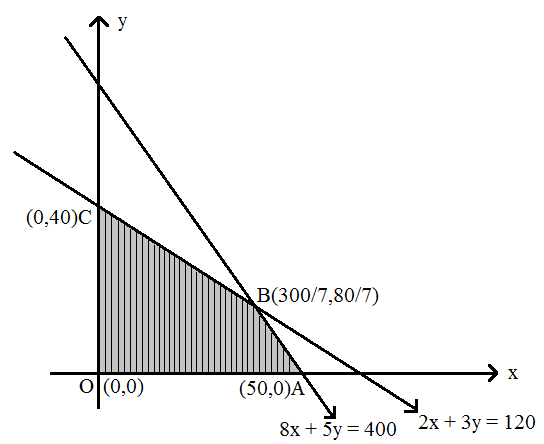
These inequalities are plotted as shown in the following figure.
From the figure shaded region is bounded with the corner points O(0, 0), A(50, 0), $\text{B}\Big(\frac{300}{7},\frac{80}{7}\Big),$ C(0, 0)
Corner points
Corresponding value of Z = x + y
(0, 0)
0
(50, 2)
50
$\Big(\frac{300}{7},\frac{80}{7}\Big)$
$\frac{380}{7}=54\frac{2}{7}\text{km (maximum)}$
(0, 40)
40
Hence, the maximum distance that the man can travel is $54\frac{2}{7}\text{km}.$

Need a full question paper?

Generate a complete, print-ready paper with questions like this in minutes — across 16+ boards, with answer keys.

Start Generating Free

Similar questions

If $\text{x}=\text{a}\sin\text{t}-\text{b}\cos\text{t},\text{y}=\text{a}\cos\text{t}+\text{b}\sin\text{t},$ Prove that $\frac{\text{d}^2\text{y}}{\text{dx}^2}=-\frac{\text{x}^2+\text{y}^2}{\text{y}^2}$
Verify Rolle's theorem for the following function on the indicated intervals$f(x) = x(x^- 4)^2$ on the interval $[0, 4]$
Solve the following differential equation
$\sin^4\text{x}\frac{\text{dy}}{\text{dx}}=\cos\text{x}$
For the following pairs of matrices verify that $(AB)^{-1} = B^{-1} A^{-1}:$
$\text{A}=\begin{bmatrix}2 & 1 \\5 & 3 \end{bmatrix}\text{ and B}=\begin{bmatrix}4 & 5 \\3 & 4 \end{bmatrix}$
Evaluate the following integrals:$\int\frac{\text{x}-3}{\text{x}^2+2\text{x}-4}\text{ dx}$
A chemical company produces two compounds, $A$ and $B.$ The following table gives the units of ingredients, $C$ and $D$ per kg of compounds $A$ and $B$ as well as minimum requirements of $C$ and $D$ and costs per kg of $A$ and $B$. Find the quantities of $A$ and $B$ which would give a supply of $C$ and $D$ at a minimum cost.
 
Compound
Minimum requirement
$A$
$B$
 
Ingredient $C$
$1$
$2$
$80$
Ingredient $D$
$3$
$1$
$75$
Coist $($in Rs.$)$ per Kg
$4$
$6$
 
A(1, 0, 4) B(0, -11, 1), C(2, -3, 1) are three points and D is the fool of perpendicular from A on BC. Find the coordinates of D.
Solve the following equation for x:
$\tan^{-1}\frac{1}{4}+2\tan^{-1}\frac{1}{5}+\tan^{-1}\frac{1}{6}+\tan^{-1}\frac{1}{\text{x}}=\frac{\pi}{4}$
If $\text{x}\sqrt{1+\text{y}}+\text{y}\sqrt{1+\text{x}}=0,$ prove that $(1+\text{x})^2\frac{\text{dx}}{\text{dx}}+1=0$
Find a unit vector perpendicular to the plane containing the vectors $\vec{\text{a}}=2\hat{\text{i}}+\hat{\text{j}}+\hat{\text{k}}$ and $\vec{\text{b}}=\hat{\text{i}}+2\hat{\text{j}}+\hat{\text{k}.}$