Question
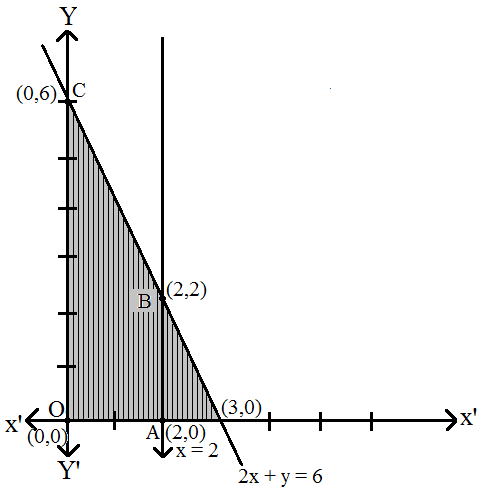
Determine the maximum value of $\text{Z}=11\text{x}+7\text{y}$ subject to the constraints:
$2\text{x}+\text{y}\leq6,\text{x}\leq2,\text{x}\geq0,\text{y}\geq0. $
Answer

We have, maximise $\text{Z}=11\text{x}+7\text{y}\ .....(\text{i})$
Subject to the constraints
$2\text{x}+\text{y}\leq6\ .....(\text{ii})$
$\text{x}\leq2\ ......(\text{iii})$
$\text{x}\geq0,\text{y}\geq0\ .....(\text{iv}) $
We see that, the feasible region as shaded determined by the system of constraint (ii) to (iv) is OABC and is bounded. So, now we shall use corner point method to determine the maximum value of Z.
Corner Points
Corresponding value of Z
(0, 0)
(2, 0)
(2, 2)
(0, 6)
0
22
36
42 (Maximum)
Hence, the maximum value of Z is 42 at (0, 6).

Need a full question paper?

Generate a complete, print-ready paper with questions like this in minutes — across 16+ boards, with answer keys.

Start Generating Free

Similar questions

Verify Lagrange's mean value theorem for the following function on the indicated intervals. find a point 'c' in the indicated interval as stated by the Lagrange's mean value theorem.
$\text{f}(\text{x})=\tan^{-1}\text{x}\text{ on }[0,1]$
Let $d_1, d_2, d_3$ be three mutually exclusive diseases. Let $S$ be the set of observable symptoms of these diseases. $A$ doctor has the following information from a random sample of 5000 patients: 1800 had disease $d_1, 2100$ has disease $d _2$, and others had disease $d _3 .1500$ patients with disease $d _1, 1200$ patients with disease $d _2$, and 900 patients with disease $d_3$ showed the symptom. Which of the diseases is the patient most likely to have?
Solve the following system of homogeneous linear equations:
3x + y + z = 0,
x - 4y + 3z = 0,
2x + 5y - 2z = 0
If $\text{xy}=4,$ prove that $\text{x}\Big(\frac{\text{dy}}{\text{dx}}+\text{y}^2\Big)=3\text{y}$
Find the adjoint of the following matrices: $\begin{bmatrix} \text{a} & \text{b} \\ \text{c} & \text{d} \end{bmatrix}$Verify that (adjoint A) $A = |A|I = A$ (adjoint A) for the above matrices.
Show that the lines $\frac{5 - x }{-4} =\frac{\text{y}- 7}{4} = \frac{\text{z} + 3}{-5}\text{ and } \frac{{x} - 8}{7} =\frac{2\text{y} - 8}{2} =\frac{\text{z} - 5 }{3}$ are coplanar.
Integrate the function $\frac{6 x+7}{\sqrt{(x-5)(x-4)}}$
Maximize $Z = 3x_1 + 4x_2,$ if possible,
Subject to the constraints
$\text{x}_1-\text{x}_2\leq-1$
$-\text{x}_1+\text{x}_2\leq0$
$\text{x}_1,\text{x}_2\geq0$
Evaluate the following:
$\int\frac{\sin^6\text{x}+\cos^6\text{x}}{\sin^2\text{x}\cos^2\text{x}}\text{dx}$
If $x = \tan \Bigg(\frac{1}{\text{a}}\log \text{y}\Bigg),$show that
$(1+\text{x}^{2})\frac{\text{d}^{2}\text{y}}{\text{dx}^{2}}+(\text{2x - a})\frac{\text{dy}}{\text{dx}}=0$.