Question
  1. Determine the value of phase difference between the current and the voltage in the given series $\text{LCR}$ circuit.
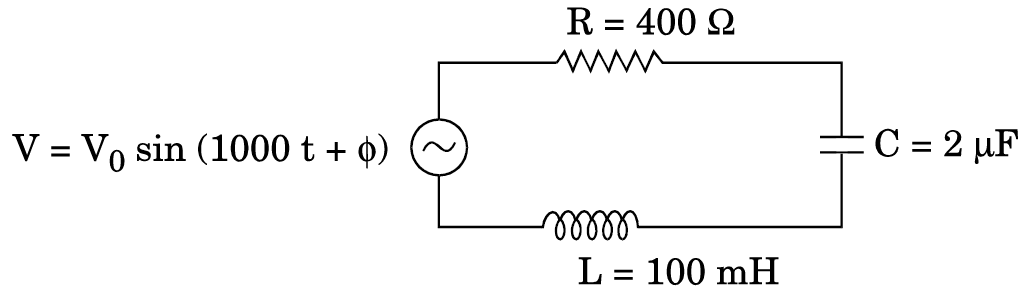
  1. Calculate the value of the additional capacitor which may be joined suitably to the capacitor $C$ that would make the power factor of the circuit unity.
Answer

  1. In $\text{LCR}$ circuit: $\tan\varphi= \frac{\text{X}_{L} - \text{X}_{c}}{\text{R}} = \frac{\text{wL} - \frac{1}{\text{wC}}}{\text{R}}$
Now $\text{X}_{L} = \text{wL} = ( 1000\times100\times10^{-3})\Omega$
$= 100\Omega$
and $\text{X}_{c} = \frac{1}{\text{wc}} = \bigg(\frac{1}{100\times2\times10^{-6}}\bigg)\Omega$
$\therefore\text{X}_{c} = 500 \Omega$
$\therefore\tan\varphi = \frac{500 - 100}{400} = 1 $
$\tan\varphi = 1 $
$\varphi = 45^{o}$
  1. Power Factor:
When power factor $= 1,$ we have $X_L=X_C$
$\therefore\text{X'}_{c} = \frac{1}{\omega\text{C}'} = 100 \Omega$
This gives $\text{C'} = \frac{1}{100\omega} = 10 \mu\text{F}$
We, therefore, need to add a capacitor of capacitance $(10-2) \mu F = 8\mu F$ in parallel with the given capacitor.
Alternate Answer
Let addition capacitance $C_1$ be connected:
$\text{X}'_{c} = \frac{1}{1000(2 + \text{C}_{1})\times10^{-6}}$
$\therefore100 = \frac{1}{1000(2 + \text{C}_{1})\times10^{-6}}$
$\therefore2 + \text{C}_{1} = 10 $
$\text{C}_{1} = 8 \mu\text{F}$.

Need a full question paper?

Generate a complete, print-ready paper with questions like this in minutes — across 16+ boards, with answer keys.

Start Generating Free

Similar questions

Let x and a stand for distance. Is $\int\frac{\text{dx}}{\sqrt{\text{a}^2-\text{x}^2}}=\frac{1}{\text{a}}\sin^{-1}\frac{\text{a}}{\text{x}}$ dimensionally correct?
  1. State Bohr’s postulate to define stable orbits in hydrogen atom. How does de Broglie’s hypothesis explain the stability of these orbits?
  2. A hydrogen atom initially in the ground state absorbs a photon which excites it to the $n = 4$ level. Estimate the frequency of the photon.
A circular coil of radius $8.0\ cm$ and $20$ turns is rotated about its vertical diameter with an angular speed of $50$ rad $s^{–1}$ in a uniform horizontal magnetic field of magnitude $3.0 \times 10^{–2}T$. Obtain the maximum and average emf induced in the coil. If the coil forms a closed loop of resistance $10\Omega ,$ calculate the maximum value of current in the coil. Calculate the average power loss due to Joule heating. Where does this power come from?
A hydrogen atom emits ultraviolet radiation of wavelength 102.5nm. What are the quantum numbers of the states involved in the transition?
A converging lens and a diverging mirror are placed at a separation of 15cm. The focal length of the lens is 25cm and that of the mirror is 40cm. Where should a point source be placed between the lens and the mirror so that the light, after getting reflected by the mirror and then getting transmitted by the lens, comes out parallel to the principal axis?
A resistance of $R \Omega$ draws current from a potentiometer as shown in the figure. The potentiometer has a total resistance $R_o\Omega$ . A voltage $V$ is supplied to the potentiometer. Derive an expression for the voltage across $R$ when the sliding contact is in the middle of the potentiometer.
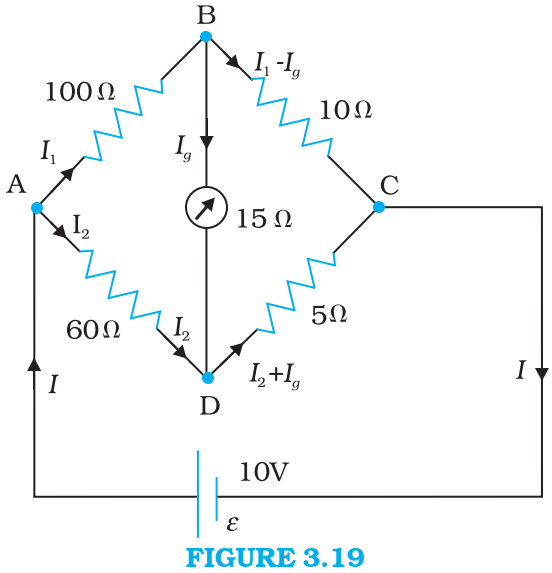
The four arms of a Wheatstone bridge $($Fig. $3.19)$ have the following resistances:
$AB =100 \Omega, BC =10 \Omega, CD =5 \Omega \text {, and } DA =60 \Omega \text {. }$
Image
A galvanometer of $15 \Omega$ resistance is connected across $BD$. Calculate the current through the galvanometer when a potential difference of $10 V$ is maintained across $AC$.
Two charges $5nC$ and $-2nC$ are placed at points $(5\ cm, 0, 0)$ and $(23\ cm, 0, 0)$ in a region of space where there is no other external field. Calculate the electrostatic potential energy of this charge system.
An ideal battery sends a current of 5A in a resistor. When another resistor of value $10\Omega$ is connected in parallel, the current through the battery is increased to 6A. Find the resistance of the first resistor.
  1. Define ‘activity’ of a radioactive material and write its $S.I.$ unit.
  2. Plot a graph showing variation of activity of a given radioactive sample with time.
  3. The sequence of stepwise decay of a radioactive nucleus is

If the atomic number and mass number of $D_2$ are $71$ and $176$ respectively, what are their corresponding values for $D$?
