Question
  1. Determine the value of phase difference between the current and the voltage in the given series LCR circuit.
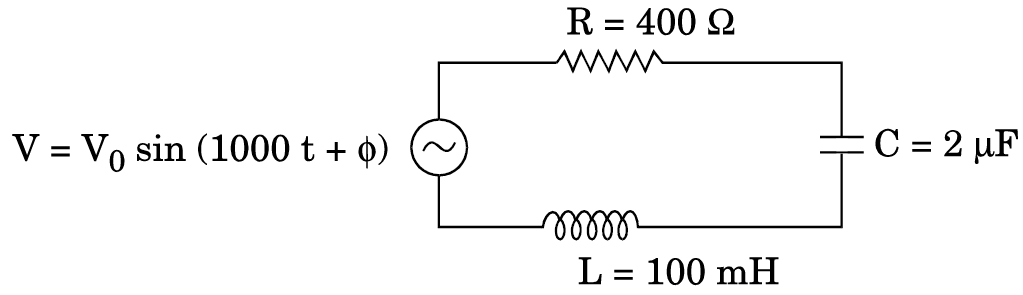
  1. Calculate the value of the additional capacitor which may be joined suitably to the capacitor C that would make the power factor of the circuit unity.
Answer

  1. In LCR circuit: $\tan\varphi= \frac{\text{X}_{L} - \text{X}_{c}}{\text{R}} = \frac{\text{wL} - \frac{1}{\text{wC}}}{\text{R}}$
Now $\text{X}_{L} = \text{wL} = ( 1000\times100\times10^{-3})\Omega$
$= 100\Omega$
and $\text{X}_{c} = \frac{1}{\text{wc}} = \bigg(\frac{1}{100\times2\times10^{-6}}\bigg)\Omega$
$\therefore\text{X}_{c} = 500 \Omega$
$\therefore\tan\varphi = \frac{500 - 100}{400} = 1 $
$\tan\varphi = 1 $
$\varphi = 45^{o}$
  1. Power Factor:
When power factor = 1, we have $X_L=X_C$
$\therefore\text{X'}_{c} = \frac{1}{\omega\text{C}'} = 100 \Omega$
This gives $\text{C'} = \frac{1}{100\omega} = 10 \mu\text{F}$
We, therefore, need to add a capacitor of capacitance (10-2) μF = 8μF in parallel with the given capacitor.
Alternate Answer
Let addition capacitance $C_1$ be connected:
$\text{X}'_{c} = \frac{1}{1000(2 + \text{C}_{1})\times10^{-6}}$
$\therefore100 = \frac{1}{1000(2 + \text{C}_{1})\times10^{-6}}$
$\therefore2 + \text{C}_{1} = 10 $
$\text{C}_{1} = 8 \mu\text{F}$.

Need a full question paper?

Generate a complete, print-ready paper with questions like this in minutes — across 16+ boards, with answer keys.

Start Generating Free

Similar questions

Find the moment of inertia of a uniform square plate of mass m and edge a about one of its diagonals.
Is the motion of a charge across junction momentum conserving? Why or why not?
The band gap for silicon is 1.1eV.
  1. Find the ratio of the band gap to kT for silicon at room temperature 300K.
  2. At what temperature does this ratio become one tenth of the value at 300K?
(Silicon will not retain its structure at these high temperatures.)
A block at rest explodes into three equal parts. Two parts start moving along X and Y axes respectively with equal speeds of 10m/s. Find the initial velocity of the third part.
A point object is placed on the principal axis of a convex lens (f = 15cm) at a distance of 30cm from it. A glass plate $(\mu=1.50)$ of thickness 1cm is placed on the other side of the lens perpendicular to the axis. Locate the image of the point object.
When an inductor L and a resistor R in series are connected across a 12 V, 50 Hz supply, a current of 0.5 A flows in the circuit. The current differs in phase from applied voltage by $\pi/3$ radian. Calculate the value of R.
Obtain the formula for the electric field due to a long thin wire of uniform linear charge density λ without using Gauss’s law.
[Hint: Use Coulomb’s law directly and evaluate the necessary integral.]
Draw the graph of binding energy per nucleon against atomic mass number and draw conclusion of the graph.
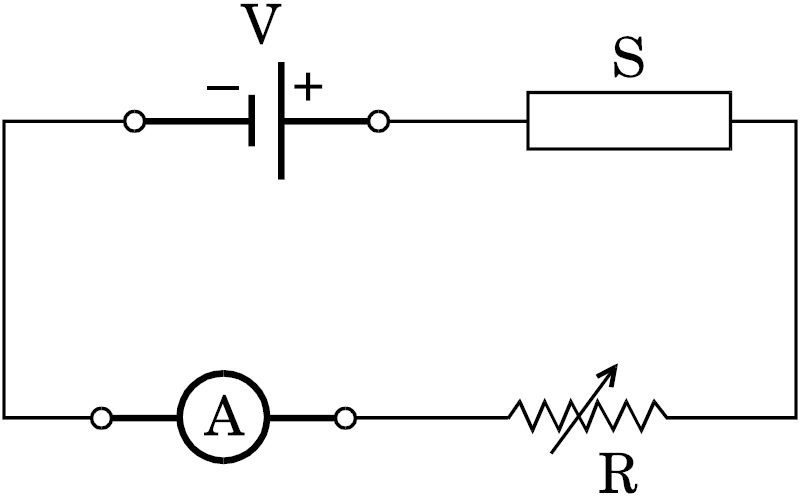
  1. In the following diagram ‘S’ is a semiconductor. Would you increase or decrease the value of R to keep the reading of the ammeter A constant when S is heated? Give reason for your answer.
  1. Draw the circuit diagram of a photodiode and explain its working. Draw its I - V characteristics.
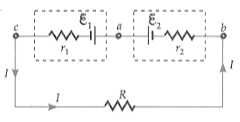
In Figure, $\varepsilon_1$ and $\varepsilon_2$ are respectively 2.0 V and 4.0 V and the resistances $r _1, r _2$ and R are respectively $1.0 \Omega$ $2.0 \Omega$ and $5.0 \Omega$. Calculate the current in the circuit. Also, calculate:
i. potential difference between the points b and a,
ii. potential difference between a and c.
Image