Question
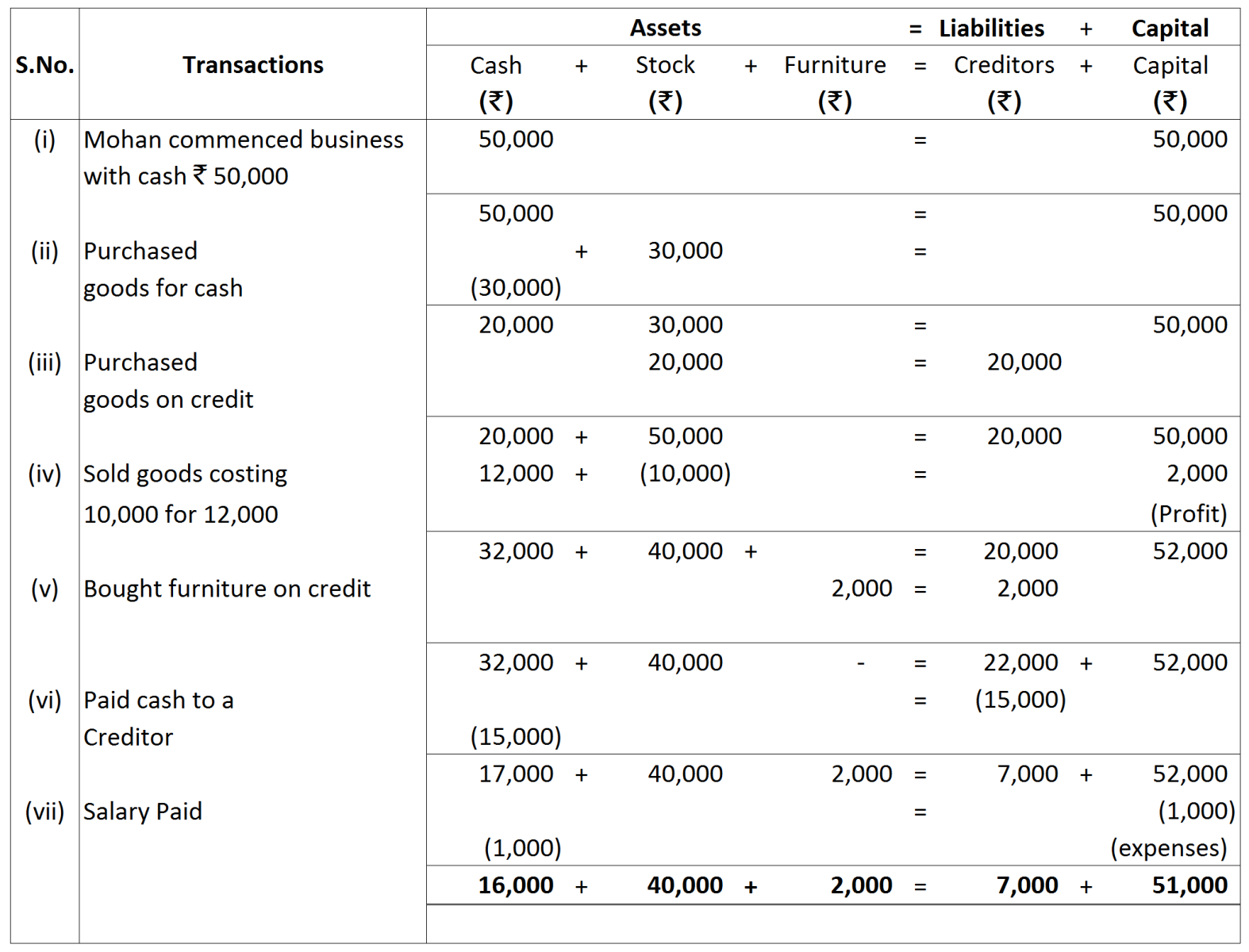
Develop an Accounting Equation from the following transactions:
S.no  
(i) Mohan commenced business with cash 50,000
(ii) Purchased goods for cash 30,000
(iii) Purchased goods on credit 20,000
(iv) Sold goods (costing ₹ 10,000) for 12,000
(v) Bought furniture on credit 2,000
(vi) Paid cash to a creditor 15,000
(vii) Salary paid 1,000

Answer


Assets = 16,000 + 40,000 + 2,000 = ₹ 58,000
Liabilities = ₹ 7,000
Capital = ₹ 51,000

Need a full question paper?

Generate a complete, print-ready paper with questions like this in minutes — across 16+ boards, with answer keys.

Start Generating Free

Similar questions

The Trial Balance prepared by a Book-keeper showed a difference of ₹ 1,006 which was placed in a newly opened Suspense Account and carried forward to the next year, when the following errors were discovered:-
  1. Goods purchased for ₹ 99 had been posted to the credit of the supplier as ₹ 990.
  2. ₹ 75 received as discount from a creditor was duly entered in his account but it was omitted to be posted to discount account.
  3. Sale of Furniture for ₹ 1,400 had been entered in sales book.
  4. ₹ 900 due from a customer were omitted to be taken to the Schedule of sundry debtors.
  5. Goods of the value of ₹ 3,000 returned by a customer were taken into the stock but no entry was made in the books.
  6. ₹ 355 entered in the Sales Returns book had been posted to the debit of the customer who returned the goods.
Give necessary Journal entries to rectify the above errors and prepare suspense account.
What is asset disposal account? Why is it prepared? Give journal entries for preparation of this account when an asset is disposed off.
What is Trial Balance? Does the balancing of this ensure accuracy of books of accounts.
From the following information supplied by Sanjay, prepare his Bank Reconciliation Statement as on 31st March, 2019:
   
(i) Bank overdraft as per Pass Book. 16,500
(ii) Cheques issued but not presented for payment. 8,750
(iii) Cheques deposited with the Bank but not collected. 10,500
(iv) Cheques recorded in the Cash Book but not sent to the bank for collection. 2,000
(v) Payments received from customers directly by the bank. 3,500
(vi) Bank charges debited in the Pass Book. 200
(vii) Premium on life policy of Sanjay paid by the bank on standing advice. 1,980
(viii) A bill for ₹ 3,000 (discounted with the bank in February) dishonoured on 31st March, 2019 and noting charges paid by the bank. 100
A Trial Balance showed excess credit of ₹ 2,728, which were placed in a suspense account. Later on the following errors were located. Pass rectifying entries and prepare Suspense A/c.
  1. ₹ 825, the total of purchase return book has been posted to the debit of sales return account.
  2. Goods purchased from Suresh ₹ 1,800 recorded in Sales Book as ₹ 180.
  3. An item of ₹ 328 written off as a bad debt from Ajay Sharma has not been debited to Bad Debts Account.
  4. Goods purchased from X ₹ 3,500 and from Y ₹ 4,000, but were recorded in the purchase book as X ₹ 4,000 and Y ₹ 3,500.
  5. Goods returned to Ramesh for ₹ 2,600 was correctly recorded in the return outward book but was wrongly posted to his account as ₹ 260.
  6. A sum of ₹ 2,210 stolen by an ex-employee stand debited to Suspense A/c.
  7. A sum of ₹ 500 written off as depreciation on Machinery, were not posted to Machinery account.
On 1st January, 2019, X sold goods of ₹ 20,000 to Y and drew a bill on Y at three months for the amount. Y accepted the bill. The bill is met on maturity. Pass the necessary Journal entries in the books of X and Y, if X discounted the bill @ 12% p.a. from bank on 4th January.
Prepare a Bank Reconciliation Statement from the following particulars as on 31st March 2015:
  1. Cheques were deposited into bank on 25th March for ₹ 20,000. Out of these cheques for ₹ 8,000 were cleared on 4th April, cheques for ₹ 6,000 on 6th April and one cheque for ₹ 1,400 was dishonoured on 7th April.
  2. Cheques amounting to ₹ 12,000 were issued in March, out of which cheques for ₹ 2,000 were encashed upto 31st March.
  3. A bill for ₹ 5,000 (discounted with the bank in January) dishonoured on 30th March 2015 and noting charges paid by bank ₹ 50. No information regarding the dishonour was received from the bank in March 2015.
  4. Cheque issued to a creditor for ₹ 2,000 was through mistake entered in the cash column of the Cash Book. The same has not been presented for payment till today.
  5. Receipt side of the Cash Book (bank column) was undercast by ₹ 100.
  6. Bank has paid a bill payable amounting to ₹ 2,500 but it has not been entered in the Cash Book.
  7. A cheque for ₹ 2,000 issued to Mr. X was omitted to be recorded in Cash Book.
  8. Dr. balance as per Pass Book was ₹ 7,200.
Nikhil sold goods for ₹ 23,000 to Akhil on Dec. 01, 2017. He drew upon Akhil a bill of exchange for the same amount payable after 2 months. Akhil accepted the bill and sent it back to Nikhil. Nikhil discounted the bill immediately with his bank @12 p.a. On the due date Akhil dishonoured the bill of exchange and the bank paid ₹ 100 as noting charges. Akhil requested Nikhil to draw a new bill upon him with interest @10% p.a. which he agreed. The new bill was payable after two months. A week before the maturity of the second bill Akhil requested Nikhil to cancel the second bill. He further requested to accept ₹ 10,000 in cash immediately and drew a third bill upon him including interest of ₹ 500. Nikhil agreed to Akhil’s request. The third bill was payable after one month. Akhil met the third bill on its maturity. record the necessary journal entries in the books of Nikhil and Akhil and also prepare Akhil’s account in the books of Nikhil and Nikhil’s account in the books of Akhil.
Journalise the following in the books of Som Nath & Sons:
2019  
May 1 Purchased a Machinery for ₹ 1,00,000 and the payment was made by issuing a cheque from Proprietor's saving bank account.
May 4 Received an order from Chakravarti for goods of ₹ 4,00,000 alongwith a cheque of 10% of the order as advance.
May 8 Paid cash ₹ 8,000 to Dushyant and discount allowed by him ₹ 800.
May 10 Goods stolen by an employee (Sale Price ₹ 20,000; Cost ₹ 15,000).
May 15 Purchased stationery worth ₹ 8,000 for office use and ₹ 2,000 for personal use.
May 20 Manoj pays us ₹ 5,400 after deducting 10% for prompt payment.
May 28 Sold goods to Kuber costing ₹ 2,00,000 at 25% above cost less trade discount of 10% and cash discount of 5%. Kuber did not avail the cash discount.
Rectify the following errors which were detected before preparing the Trial Balance:
  1. Purchase book has been overcast by ₹ 1,000.
  2. Purchase from Ram ₹ 20,000 has been omitted to be posted to his account.
  3. Purchase from Shyam ₹ 15,000 has been posted to the debit side of his account.
  4. Purchase from Ghanshyam ₹ 10,000 has been posted to his account as ₹ 1,000.
  5. Purchase from Sita Ram ₹ 5,000 has been posted to his account as ₹ 50,000.