Question
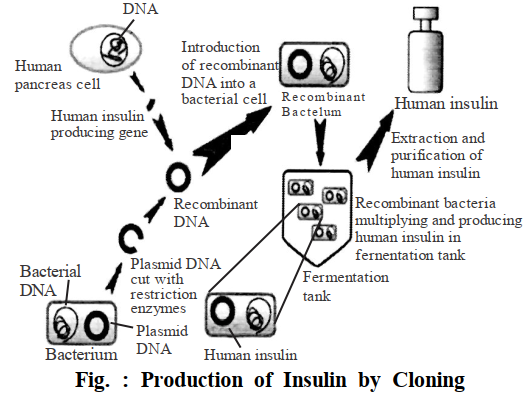
Diagrammatically represent the experimental steps in cloning and expressing an human gene (say the gene for growth hormone) into a bacterium like E.coli.

Answer

Diabetes in humans is caused by faulty functioning of pancreas. It is not able to produce insulin adequately. Defective functioning of pancreas results in excess sugar in the body and inability to control the sugar level in the blood. Its only treatment is possible through insulin.
Insulin, used to treat diabetes patients, was extracted from the pancreas of animals and pigs by killing them Insulin derived from animals has caused allergies or other reactions to foreign proteins in some patients. Insulin is made up of two short polypeptide chains, Chain 'A' and Chain 'B'. These chains are connected to each other by disulfide bonds. Insulin pro-hormone is synthesized in mammals including humans. Like pro-enzyme, pro-hormone also needs to be processed before becoming a fully mature and functional hormone. This synthesized insulin hormone has an additional stretch called peptide 'C'. This 'C' peptide gets separated from insulin during maturation, hence the 'C' peptide is absent in mature insulin (Fig. 10.3).
The main challenge in producing insulin using recombinant DNA technologies (r.DNA) is to assemble and prepare the insulin in its mature form In 1983, an American company named Eli Lilly prepared DNA sequences that correspond to chains 'A' and 'B' of human insulin, which were inserted into the plasmid of E. coli and produced insulin chains. Chains A and B were produced separately, extracted and combined by creating disulfide bonds to form human insulin.
Image
'C' peptide contains 35 amino acids and it has been observed that 6 amino acids of 'C' peptide are capable of binding function. The insulin producing gene was cloned in bacteria and used for the synthesis of insulin. The work of gene cloning of insulin was done by Dr. Saran Narang of Indian origin who was working in Ottawa, Canada. This insulin has been named Humiline and it is being sold in the markets.
By this technology, Human Growth Hormone (HGH) protopin has been manufactured in 1986. It is used for the treatment of dwarfism.

Need a full question paper?

Generate a complete, print-ready paper with questions like this in minutes — across 16+ boards, with answer keys.

Start Generating Free

Similar questions

What are the methods of cancer detection? Describe the common approaches for treatment of cancer.
Enumerate the different measures for control and prevention of drug/ alcohol abuse among adolescent.
A pregnant woman who have had amniocentesistest was advised to undergo MTP. It was diagnosed by her doctor that the embryo she is carrying has an extra barr body.
  1. Name the syndrome which is likely to be associated with the embryo.
  2. Why was she advised to undergo MTP?
  3. Do you justify the statutory ban on amniocentesis in our country Give reasons.
The zygote passes through several development stages till implantation. Describe each stage briefly with suitable diagrams.
Draw a diagrammatic sketch of biogas plant, and label its various components given below: Gas Holder, Sludge Chamber, Digester, Dung + water chamber.
Collect 5 examples of palindromic DNA sequences by consulting your teacher. Better try to create a palindromic sequence by following the base-pair rules.
What is Gametogenesis? Explain in detail the process of spermatogenesis and oogenesis.
Your school’s athletic team along with the athletic teams from different schools reach the venue two days before the inter district school athletic event was to be held. A day before the competition, a team of officials from an agency arrive and ask for blood and urine samples from all the participating athletes.
  1. Would you support or object to this sample collection? Provide explanation to your answer.
  2. Write a note that you would like to read out to your team-mates to explain the purpose of this visit of these officials.
a. Describe the process of double fertilisation in angiosperms.
b. Trace the development of polyploidal cell that is formed after double fertilisation in a non-albuminous seed and albuminous seed.
Describe the functions of the following:
Epididymis.