Question
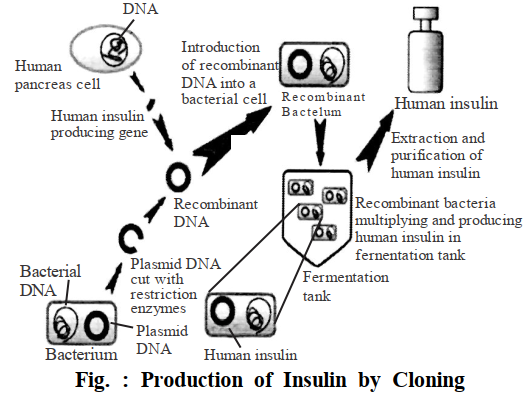
Diagrammatically represent the experimental steps in cloning and expressing an human gene (say the gene for growth hormone) into a bacterium like E.coli.

Answer

Diabetes in humans is caused by faulty functioning of pancreas. It is not able to produce insulin adequately. Defective functioning of pancreas results in excess sugar in the body and inability to control the sugar level in the blood. Its only treatment is possible through insulin.
Insulin, used to treat diabetes patients, was extracted from the pancreas of animals and pigs by killing them Insulin derived from animals has caused allergies or other reactions to foreign proteins in some patients. Insulin is made up of two short polypeptide chains, Chain 'A' and Chain 'B'. These chains are connected to each other by disulfide bonds. Insulin pro-hormone is synthesized in mammals including humans. Like pro-enzyme, pro-hormone also needs to be processed before becoming a fully mature and functional hormone. This synthesized insulin hormone has an additional stretch called peptide 'C'. This 'C' peptide gets separated from insulin during maturation, hence the 'C' peptide is absent in mature insulin (Fig. 10.3).
The main challenge in producing insulin using recombinant DNA technologies (r.DNA) is to assemble and prepare the insulin in its mature form In 1983, an American company named Eli Lilly prepared DNA sequences that correspond to chains 'A' and 'B' of human insulin, which were inserted into the plasmid of E. coli and produced insulin chains. Chains A and B were produced separately, extracted and combined by creating disulfide bonds to form human insulin.
Image
'C' peptide contains 35 amino acids and it has been observed that 6 amino acids of 'C' peptide are capable of binding function. The insulin producing gene was cloned in bacteria and used for the synthesis of insulin. The work of gene cloning of insulin was done by Dr. Saran Narang of Indian origin who was working in Ottawa, Canada. This insulin has been named Humiline and it is being sold in the markets.
By this technology, Human Growth Hormone (HGH) protopin has been manufactured in 1986. It is used for the treatment of dwarfism.

Need a full question paper?

Generate a complete, print-ready paper with questions like this in minutes — across 16+ boards, with answer keys.

Start Generating Free

Similar questions

In the medium where E. coli was growing. lactose was added, which induced the lac operon. Then, why does lac operon shut down some time after addition of lactose in the medium.
The following is the illustration of the sequence of ovarian events (a – i) in a human female.

What is the difference between “d” and “e” ?

A child suffering from thalassemia is born to a normal couple. But the mother is being blamed by the family for delivering a sick baby.
  1. What is Thalassemia?
  2. How would you counsel the family not to blame the mother for delivering a child suffering from this disease? Explain.
  3. List the values your counselling can propagate in the families.
Represent diagrammatically the steps in amplification of a DNA segment. Who designed the process?
What are sexually transmitted diseases? Write the names of these diseases. Also describe the two diseases with special reference on their mode of transmission symptoms and the preventive measures against them.
Read the following and answer any four questions from (i) to (v) given below:

Gene therapy is the technique of genetic engineering to replace a faulty gene by a normal healthy functional gene. It is a way of treating genetic disease by introducing a piece of DNA into the cells of an affected individual. Liposomes can be used for gene therapy as they target the cells affected by a genetic disease.

  1. A patient suffers from adenosine deaminase (ADA) deficiency, an autosomal recessive immune deficiency in which bone marrow lymphoblasts cannot replicate to generate immuno-competent lymphocytes. The treatment option that would cure the patient is:
  1. Germ-line gene therapy to replace one ADA gene copy.
  2. Germ-line gene therapy to replace both ADA gene copies.
  3. Somatic cell gene therapy to replace both ADA gene copies in circulating lymphocytes.
  4. Somatic cell gene therapy to replace one ADA gene copy in bone marrow lymphoblasts.
  1. Which type of gene therapy is least effective in transferring DNA to the nucleus?
  1. Adenoviruses.
  2. DNA attached to a ligand.
  3. Liposomes.
  4. Retroviruses.
  1. Liposomes can be used for gene therapy as they target the cells affected by a genetic disease. The diagram shows the structure of a liposome.

What feature of a cell surface membrane allows the liposome to target cells affected by a genetic disease? 

  1. Carrier molecules.
  2. Phosphate groups.
  3. Protein channels.
  4. Receptor molecules.
  1. Which of the following disorders would gene therapy be least effective?
  1. Cystic fibrosis.
  2. Huntington's disease.
  3. Sickle cell anaemia.
  4. Type II diabetes.
  1. Following are some reasons explaining why gene therapy is not yet fully an effective treatment for genetic diseases.
  1. Lack of knowledge of DNA sequences.
  2. Lack of efficient and safe gene delivery system.
  3. Cost of the technology.
  4. Some diseases involve multiple genes.
  5. Problems with appropriate gene regulation.

Select the correct option. 

  1. I, III and V only
  2. II, IV and V only
  3. Ill, IV and V only
  4. I, III and IV only
A single base mutation in a gene may not ‘always’ result in loss or gain of function. Do you think the statement is correct? Defend your answer.
  1. What is meant by addictive disorder?
  2. Mention any two ways in which opiate narcotics affect human body.
  3. Name any two opiate narcotics.
Define acquired immunity and describe its types.
What is meant by immunity? What are the four barriers to innate immunity? Explain . Draw a labelled diagram of the structure of an antibody molecule.