MCQ
Diamminedichloro platinum $ (II) $ complex has the formula
  • A
    $Pt[C{l_2}{(N{H_3})_2}]$
  • B
    $Pt[R.{(N{H_2})_2}]C{l_2}$
  • $[PtC{l_2}{(N{H_3})_2}]$
  • D
    $[Pt.R.{(N{H_2})_2}]C{l_2}$

Answer

Correct option: C.
$[PtC{l_2}{(N{H_3})_2}]$
c
It’s obvious.

Need a full question paper?

Generate a complete, print-ready paper with questions like this in minutes — across 16+ boards, with answer keys.

Start Generating Free

Similar questions

Benzaldehyde reacts with ammonia to form
One mole of the complex compound $Co(NH_3)_5Cl_3,$ gives $3$ moles of ions on dissolution in water. One mole of the same complex reacts with two moles of $AgNO_3$ solution to yield two moles of $AgCl(s).$ The structure of the complex is :-
What will be the molarity of a solution containing $5\,g$ of sodium hydroxide in $250\,ml$ solution
In the following reaction sequence The compound $I$ is

$\mathop I\limits_{({C_3}{H_6}C{l_2})} \xrightarrow{{KOH(aq)}}II\xrightarrow[{(ii){H_2}O/{H^ + }}]{{(i)C{H_3}MgBr}}III\xrightarrow{{Anhy.ZnC{l_2} + Conc.HCl}}$ given turbidity immediately
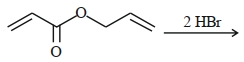
Major product of the following reaction is.
The formula weight of ${H_2}S{O_4}$ is $ 98$. The weight of the acid in $400\,ml$ of $0.1\,M$ solution is  ........... $g$
Determination of the molar mass of acetic acid in benzene using freezing point depression is affected by
The variation of equilibrium constant with temperature is given below 

Temperature $\quad$ Equilibrium constant

$\begin{array}{ll} T _{1}=25^{\circ} C & K _{1}=100 \\ T _{2}=100^{\circ} C & K _{2}=100\end{array}$

The values of $\Delta H ^{\circ}, \Delta G ^{\circ}$ at $T _{1}$ and $\Delta G ^{\circ}$ at $T _{2}$ (in $kJ\, mol ^{-1}$ ) respectively, are close to $\left[\right.$ Use $\left. R =8.314\, JK ^{-1} mol ^{-1}\right]$

Assertion : Hydrolysis of sucrose is known as inversion of cane sugar.
Reason : Sucrose is a disaccharide.
Molar conductivity of ionic solution depends on $........$
$a.$ Temperature.
$b.$ Distance between electrodes.
$c.$ Concentration of electrolytes in solution.
$d.$ Surface area of electrodes.