Question
Diffraction of light can be explained by the following:

Answer

(B) - Wave nature of light

Need a full question paper?

Generate a complete, print-ready paper with questions like this in minutes — across 16+ boards, with answer keys.
Start Generating Free

Similar questions

A signal emitted by an antenna from a certain point can be received at another point of the surface in the form of(a) Sky wave(b) Ground wave(c) Sea wave(d) Both (a) and (b)
       
What name is given to a cylindrical coil of diameter less than its length?
A ray of monochromatic light is incident on one refracting face of a prism of angle $75^\circ $. It passes through the prism and is incident on the other face at the critical angle. If the refractive index of the material of the prism is $\sqrt{2}$, the angle of incidence on the first face of the prism is
In any fission process the ratio $\frac{\text{mass of fission products}}{\text{mass of parent nucleus}}$ is 
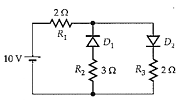
The given circuit has two ideal diodes connected as shown in the figure below. The current flowing through the resistance $R _1$ will be
Image
The bob of a simple pendulum is replaced by a magnet. The oscillations are set along the length of the magnet. A copper coil is added so that one pole of the magnet passes in and out of the coil. The coil is short-circuited. Then which one of the following happens(a) Period decreases(b) Period does not change(c) Oscillations are damped(d) Amplitude increases
   
   
For a given plate-voltage, the plate current in a triode is maximum when the potential of(a) The grid is positive and plate is negative(b) The grid is positive and plate is positive(c) The grid is zero and plate is positive(d) The grid is negative and plate is positive
   
   
In photo$-$electric effect, when photons of energy $'hv'$ are incident on a metal surface, electrons are emitted with some kinetic energy. It is possible to say that:
In a photoelectric experiment the stopping potential for the incident light of wavelength$4000\mathring{\text{A}}$ is 2 volt. If the wavelength be changed to $3000\mathring{\text{A}}$, the stopping potential will be?
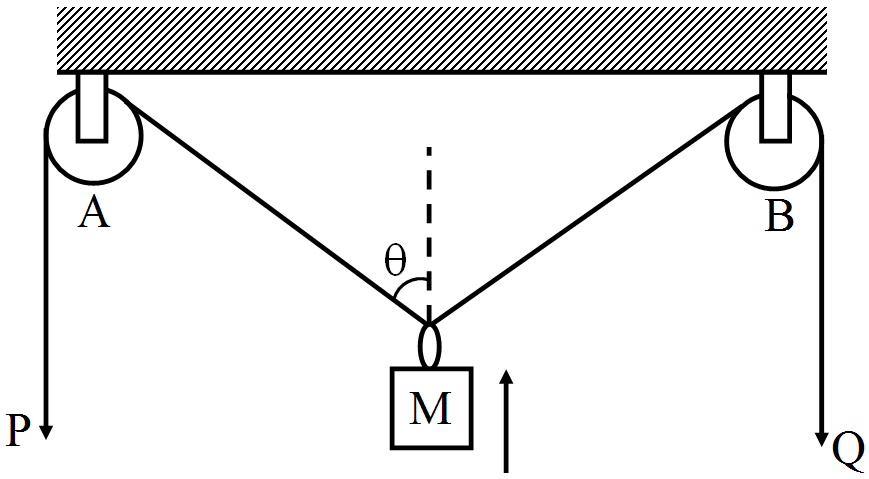
In the arrangement shown in figure, the ends P and Q of an inextensible string move downwards with uniform speed u. Pulleys A and B are fixed. The mass M moves upwards with a speed:
  1. $2\text{u}\cos\theta$
  2. $\frac{\text{u}}{\cos\theta}$
  3. $\frac{\text{2u}}{\cos\theta}$
  4. $\text{u}\cos\theta$