MCQ
Difference between the greatest and the least values of the function$f (x) = x(ln x - 2)$ on $[1, e^2]$ is
  • A
    $2$
  • $e$
  • C
    $e^2$
  • D
    $1$

Answer

Correct option: B.
$e$
b
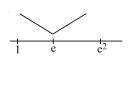
$y = x (ln x - 2)$

$y' = x\left( {\frac{1}{x}} \right) + (ln x - 2) = ln x - 1$

$\frac{{dy}}{{dx}}= ln x - 1 = 0$==>$x = e$

now$f (1) = - 2$

        $f (e) = - e$(least)

        $f (e^2) = 0$(greatest)

difference $= 0 - (-e) = e$ Ans. 
Need a full question paper?

Generate a complete, print-ready paper with questions like this in minutes — across 16+ boards, with answer keys.

Start Generating Free

Similar questions

The differential equation $\frac{d y}{d x}=F(x, y)$ will not be a homogeneous differential equation, if $F(x, y)$ is:
Evaluate : $\int \frac{d x}{\sqrt{x^2-3 x+2}}$
If the constraints in a linear programming problem are changed
  1. the problem is to be re-evaluated
  2. solution is not defined
  3. the objective function has to be modified
  4. the change in constraints is ignored
$\int_{}^{} {{x^2}\sec {x^3}\;dx} = $
The direction cosines of the ray P(1, -2, 4) and Q(-1, 1, -2) are:
  1. $\big(-2, -3, -6\big)$
  2. $\big(2, -3, -6\big)$
  3. $\Big(\frac{2}{7},\frac{3}{7},\frac{6}{7}\Big)$
  4. $\Big(-\frac{2}{7},\frac{3}{7},-\frac{6}{7}\Big)$
The vector$(s)$ which is/are coplanar with vectors $\hat{i}+\hat{j}+2 \hat{k}$ and $\hat{i}+2 \hat{j}+\hat{k}$, and perpendicular to the vector $\hat{i}+\hat{j}+\hat{k}$ is/are

$(A)$ $\hat{j}-\hat{k}$ $(B)$ $-\hat{i}+\hat{j}$ $(C)$ $\hat{i}-\hat{j}$ $(D)$ $-\hat{j}+\hat{k}$

If $\theta$ is the angle between the vectors $2\hat{\text{i}}-2\hat{\text{j}}+4\hat{\text{k}}$ and $3\hat{\text{i}}+\hat{\text{j}}+2\hat{\text{k}},$ then $\sin\theta=$
  1. $\frac{2}{3}$
  2. $\frac{2}{\sqrt{7}}$
  3. $\frac{\sqrt{2}}{7}$
  4. $\sqrt{\frac{2}{7}}$
At what point the slope of the tangent to the curve x2 + y2 - 2x - 3 = 0 is zero:
  1. (3, 0), (-1, 0)
  2. (3, 0), (1, 2)
  3. (-1, 0), (1, 2)
  4. (1, 2), (1, -2)
A root of the equation $\left| {\,\begin{array}{*{20}{c}}{3 - x}&{ - 6}&3\\{ - 6}&{3 - x}&3\\3&3&{ - 6 - x}\end{array}\,} \right| = 0$ is
If $u = 2\,i + 2j - k$ and $v = 6\,i - 3\,j + 2\,k,$ then a unit vector perpendicular to both $u$ and  $ v $ is