MCQ
Difference between the greatest and the least values of the function$f (x) = x(ln x - 2)$ on $[1, e^2]$ is
  • A
    $2$
  • $e$
  • C
    $e^2$
  • D
    $1$

Answer

Correct option: B.
$e$
b
$y = x (ln x - 2)$

$y' = x\left( {\frac{1}{x}} \right) + (ln x - 2) = ln x - 1$

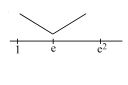
$\frac{{dy}}{{dx}}= ln x - 1 = 0$==>$x = e$

now$f (1) = - 2$

        $f (e) = - e$(least)

        $f (e^2) = 0$(greatest)

difference $= 0 - (-e) = e$ Ans. 
Need a full question paper?

Generate a complete, print-ready paper with questions like this in minutes — across 16+ boards, with answer keys.

Start Generating Free

Similar questions

If the position vectors of P and Q are $\hat{\text{i}}+3\hat{\text{j}}-7\hat{\text{k}}$ and $5\hat{\text{i}}-2\hat{\text{j}}+4\hat{\text{k}}$ then the cosine of the angle getween $\overrightarrow{\text{PQ}}$ and y-axis is:
If two events are independent, then.
${d \over {dx}}\left( {{x^2}\sin {1 \over x}} \right) = $
Each side of equilateral is increasing at the rate of 8cm/hr. The rate of increase of its area when side 2cm, is:
Let the determinant of a square matrix $A$ of order $m$ be $m-n$, where $m$ and $n$ satisfy $4 m+n=22$ and $17 m +4 n =93$. If $\operatorname{det}(n \operatorname{adj}(\operatorname{adj}( mA )))=$ $3^{ a } 5^{ b } 6^{ c }$. then $a + b + c$ is equal to:
The area bounded by the curve $\text{y}=\log_{\text{e}}\text{x}$ and x-axis and the straight line x = e is:
$\int_{}^{} {\frac{{dx}}{{1 + 3{{\sin }^2}x}} = } $
The function $\sin x - \cos x$ is increasing in the interval
The solution of the differential equation $\frac{\text{dy}}{\text{dx}}=\frac{\text{y}}{\text{x}}+\frac{\phi(\frac{\text{y}}{\text{x}})}{\phi'(\frac{\text{y}}{\text{x}})}$ is:
Let $f:\left[0, \frac{\pi}{2}\right] \rightarrow[0,1]$ be the function defined by $f(x)=\sin ^2 x$ and let $g:\left[0, \frac{\pi}{2}\right] \rightarrow[0, \infty]$ be the function defined by $g(x)=\sqrt{\frac{\pi x}{2}-x^2}$.

(There are two questions based on $PARAGRAPH "II"$, the question given below is one of them)

($1$) The value of $2 \int^{\frac{\pi}{2}} f(x) g(x) d x-\int^{\frac{\pi}{2}} g(x) d x$ us

($2$) The value of $\frac{16}{\pi^3} \int_0^{\frac{\pi}{2}} f(x) g(x) d x$ is

Give the answer or quetion ($1$) and ($2$)