Question
Differentiate between a convex and a concave lens.

Answer

S.No.
Convex Lens
Concave Lens
$1.$
Convex lenses are thicker in the middle than at the edges.
Concave lenses are thinner in the middle than at the edges.
$2.$
A convex lens can forms real and inverted image. When the object is placed very close to the lens, the image formed is virtual, erect and magnified.
A concave lens always forms erect, virtual and smaller image than the object.
$3.$
A convex lens can be used as a.
A concave lens cannot be used as.
$4.$
Magnifying glass A convex lens converges (bends inward) the light generally falling on it.
A magnifying glass A concave lens diverges (bends outward) the light.

Need a full question paper?

Generate a complete, print-ready paper with questions like this in minutes — across 16+ boards, with answer keys.
Start Generating Free

Similar questions

Draw a labelled diagram showing inhalation and exhalation process in human beings.
With the help of an activity, explain how will you measure the time period of a simple pendulum.
Respiration in fish is different from humans. Explain in brief how fishes can breathe through gills?
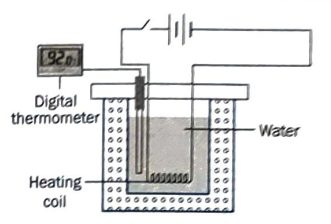
A student performs an experiment where he uses a heating coil to heat the water as shown in the figure. The initial temperature of the water is measured as $10^{\circ} C$. After switching it ON for 5 min, the student records the temperature of the water as $18^{\circ} C$.
Image

The water is allowed to return back to its initial temperature. The activity is then repeated with another heating coil having half the length of the original heating coil. He notices that after 5 min, the temperature of the water reads $14^{\circ} C$. Which statement can be concluded based on the activity?
(a) Reading on thermometer reduces with time.
(b) Temperature of water drops with every repetition.
(c) Length of the material affects the amount of heating.
(d) Temperature of the water increases after a certain period of time.
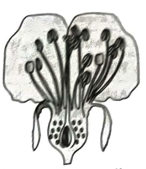
In the figure of a flower given below, label the parts whose functions are given below and give their names.
Image
(i) The part which contains pollen grains.
(ii) The part where the female gamete is formed.
(iii) The female reproductive part, where pollen grains germinate.
(iv) The colourful part of flower which attracts insects.
Distinguish between an electric motor and generator?
How does the process of fertilisation take place in flowers?
What is rectilinear propagation of light? How will you prove it?
Draw a labelled diagram of the human excretory system.
Different modes of nutrition has been observed in plants. What are they? Give example of each.