Question
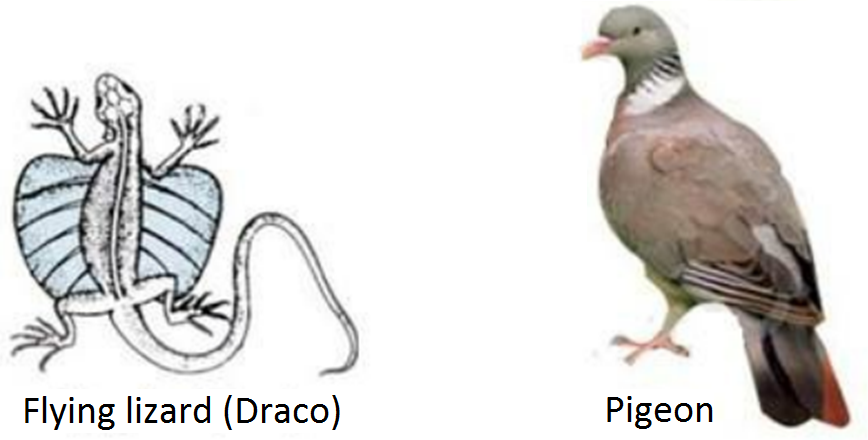
Differentiate between flying lizard and bird. Draw the diagram.
Answer

Flying lizard belongs to Class Reptilia and characterised as cold blooded, body covered with scales and having three chambered heart, while birds belong to Class Aves and have characteristics of being warm blooded, having feather covered body, forelimbs modified into wings and with four chambered heart.

Need a full question paper?

Generate a complete, print-ready paper with questions like this in minutes — across 16+ boards, with answer keys.

Start Generating Free

Similar questions

Write the modes by which insects affect the crop yield.
Tabulate the differences in the characterisitcs of states of matter.
Carry out the following osmosis experiment: Take four peeled potato halves and scoop each one out to make potato cups, one of these potato cups should be made from a boiled potato. Put each potato cup in a trough containing water. Now,
  1. Keep cup $A$ empty.
  2. Put one teaspoon sugar in cup $B$.
  3. Put one teaspoon salt in cup $C$.
  4. Put one teaspoon sugar in the boiled potato cup $D$.
Keep these for two hours. Then observe the four potato cups and answer the following:
  1. Explain why water gathers in the hollowed portion of $B$ and $C$.
  2. Why is potato $A$ necessary for this experiment?
  3. Explain why water does not gather in the hollowed out portions of $A$ and $D$.
A gun of mass $3 kg$ fires a bullet of mass $30 g$ . The bullet takes $0.003$ s to move through the barrel of the gun and acquires a velocity of $100 \mathrm{~m} / \mathrm{s}$. Calculate:
     i. The velocity with which the gun recoils.
    ii. The force exerted on gunman due to recoil of the gun.
How could you convince a small child that when ou speak, it is not necessary for air to travel from your mouth to the ear of a listener?
By which physical process the fragrance of burning an incense stick spreads all around?
What principles should be taken in account for the prevention of diseases?
Match the following column with correct answers.
  Column I   Column II
$a.$ Fungal disease $i.$ Dengue fever
$b.$ Viral disease $ii.$ Cholera
$c.$ Protozoan disease $iii.$ Skin disease
$d.$ Bacterial disease $iv.$ Malaria
Explain general characteristics of phylum Platyhelminthes and Nematoda. Give two examples of each.
Write down four characteristics of Ctenophora and give two examples.