Question
Differentiate between incomplete dominance and co-dominance. Substantiate your answer with one example of each.

Answer

Co-dominance is the phenomenon in which both the alleles of a contrasting character are expressed in the heterozygous condition. Both the alleles of a gene are equally dominant. ABO blood group in human beings is an example of co-dominance. The blood group character is controlled by three sets of alleles, namely, $I^A, I^B$, and i. The alleles, $I^A$ and $I^B$, are equally dominant and are said to be co­­-dominant as they are expressed in the AB blood group. Both these alleles do not interfere with the expression of each other and produce their respective antigens. Hence, the AB blood group is an example of co-dominance.
Allele from Parent 1
Allele from Parent 2
Genotype of offspring
Blood type of offspring
$I^A$
$I^A$
$I^A I^A$
A
$I^A$
$I^B$
$I^AI^B$
AB
$I^A$
i
$I^A i$
A
$I^B$
$I^A$
$I^A I^B$
AB
$I^B$
$I^B$
$I^BI^B$
B
$I^B$
i
$I^B i$
B
i
i
i i
O
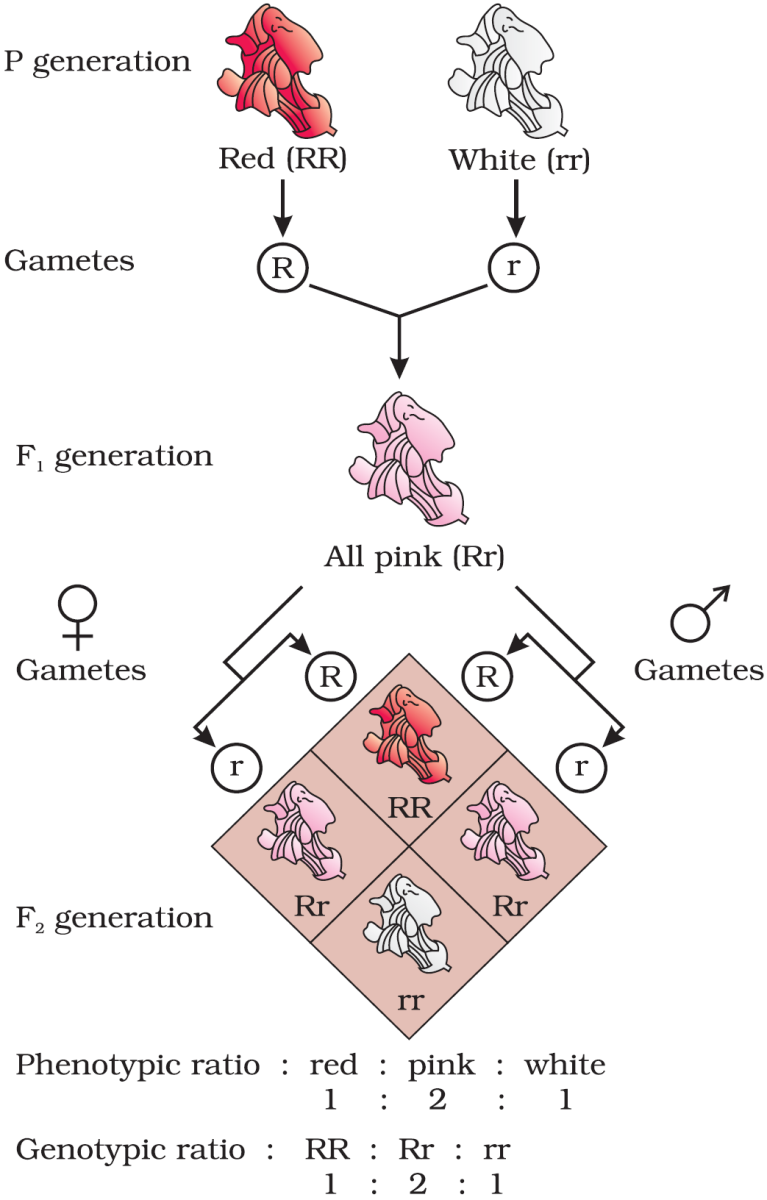
Incomplete dominance is a phenomenon in which one allele shows incomplete dominance over the other member of the allelic pair for a character. For example, a monohybrid cross between the plants having red flowers and white flowers in Antirrhinum species will result in all pink flower plants in the $F_1$ generation. The progeny obtained in $F_1$ generation does not resemble either of the parents and exhibits intermediate characteristics. This is because the dominant allele, R, is partially dominant over the other allele, r. Therefore, the recessive allele, r, also gets expressed in the $F_1$ generation resulting in the production of intermediate pink flowering progenies with Rr genotype.

Need a full question paper?

Generate a complete, print-ready paper with questions like this in minutes — across 16+ boards, with answer keys.

Start Generating Free

Similar questions

Using Punnett square demonstrate the law of independent assortment in a dihybrid cross involving two heterozygous parents.
Match the terms in Column I with those in Column II.
S. No.
Column I
 
Column II
A
Transcription
1
A set of three bases on RNA that is complementary to the bases of codon on mRNA.
B
Anticodon
2
A unit of DNA that codes for a polypeptide.
C
Cistron
3
Process of synthesis of polypeptide as dictated by mRNA.
D
Translation
4
Process by which mRNA carries the information from nucleus to ribosomes.
Microbes can be used to decrease the use of chemical fertilisers and pesticides. Explain how this can be accomplished.
What is Hardy-Weinberg principle? Discuss with suitable example.
Write short notes on the followings : (a) Predation (b) Competition
(i) Explain the significance of each of the following features present in plants given below:, (a) In rose-bay plant the stamens ripen before the stigma., (b) In certain species of primrose, the flowers have short stamen and long style., (c) The bisexual flower of mustard exhibits rejection of self-pollen grain., (ii) Explain how autogamy is prevented in castor and papaya plant respectively.
Describe the process of decomposition of detritus under the following heads: Fragmentation; leaching; catabolism; humification andmineralisation.
  1. With labelled diagrams, depict stages in embryo development in a dicotyledonous plant.
  2. Endosperm development precedes embryo development. Why?
State and explain with the help of a cross, the law of segregation as proposed by Mendel.
Describe the experiment carried out by Hershey and Chase. Write the conclusion they arrived at.