Question
Differentiate between male frog and female frog.

Answer

Differences between Male Frog and Female Frog
S.No.Male FrogFemale Frog
1.Vocal sacs are found in male frogs.Vocal sacs are not found in females.
2.Sex organs in the first finger of the male during breeding season (copulatory pad) develops.Copulatory pad is not found in females.
3.The adult male is smaller than the female.The mature female is larger than the male.

Need a full question paper?

Generate a complete, print-ready paper with questions like this in minutes — across 16+ boards, with answer keys.

Start Generating Free

Similar questions

Make a labeled diagram of Singer and Nicolson improved model of the structure of cell membrane and briefly describe it.
Can you identify the correct sequence of taxonomical categories?
  1. Species → Order → Phylum → Kingdom
  2. Genus → Species → Order → Kingdom
  3. Species → Genus → Order → Phylum
The process to standardize the naming of living organisms is called nomenclature. Obviously, the nomenclature is only possible when the organism is described correctly and we know to what organism the name is attached to this is identification. The system of providing scientific name with two components is called Binomial Nomenclature. The scientific name ensures that each organism is identified by only one name all across the world. They also ensures that such a name has not been used for any other known organism. Scientific names for plants are provided in ICBN and for animals, in ICZN.

(1). Who proposed binomial nomenclature?
(A) Carolus Linnaeus  (B) Charles Darwin  (C) Francis crick  (D) Albert Einstein

(2)Which of the following is an example of binomial scientific name?
(A) Green algae  (B) Rana tigrina  (C) Snow leopard  (D) China rose

(3). In binomial nomenclature, the name of organism consists of
(A) kingdom   (B) genus   (C) species   (D) Both B and C

(4). ICBN stands for
(A) Internal botanical congress names
(B) International center of botanical names
(C) International code of botanical nomenclature
(D) Internal code of botanical nomenclature

(5). In binomial nomenclature,------- epithet starts with small letter
(A) Genus
(B) Species
(C) Both A and B
(D) None of the above
Cell membrane, also called plasma membrane, thin membrane that surrounds every living cell, delimiting the cell from the environment around it. Enclosed by this cell membrane are the cell’s constituents, large, water-soluble, highly charged molecules such as proteins, nucleic acids, carbohydrates, and substances involved in cellular metabolism. Cell membranes are composed primarily of fatty-acid based lipids and proteins. Membrane lipids are principally of two types, phospholipids and sterols (generally cholesterol). Both types share the defining characteristic of lipids—they dissolve readily in organic solvents—but in addition they both have a region that is attracted to and soluble in water.

(1).Plasma membrane is made up of
(a) A protein, a lipid and a cellulose layer
(b) Bimolecular lipid layer surrounded by protein layers
(c) A protein layer between two lipid layers
(d) A lipid layer between two protein layers

(2) Fluid mosaic model of cell was put forward by –
(a) Danielli and Dawson
(b) Singer and Nicolson
(c) Garner and Allard
(d) Watson and Crick

(3) Which of the following statements best describes the chemical composition of
plasma-membrane?
(a) Plasma membrane is composed of two layers—one layer of phospholipids and one layer
of proteins.
(b) Plasma membrane is composed of equal numbers of phospholipids, proteins, and
carbohydrates.
(c) Plasma membrane is bilayers of proteins with associated lipids and carbohydrates.
(d) Plasma membrane is bilayers of phospholipids with associated proteins and
carbohydrates.

(4) Most abundant lipid in the cell membrane is
(a) phospholipids (b) cerebrosides (c) glycolipids (d) None of these
Write four differences between algae and fungi.
The fungi constitute a unique kingdom of heterotrophic organisms. They show a great diversity in morphology
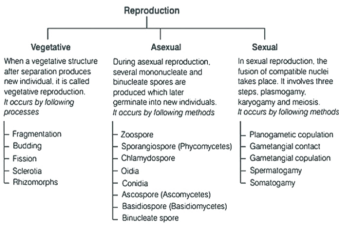
and habitat. Fungi are cosmopolitan and occur in air, water, soil, and on animals and plants. They prefer to grow in warm and humid places. Most fungi are heterotrophic and absorb soluble organic matter from dead substrates and hence are called saprophytes. When a fungus reproduces sexually, two haploid hyphae of compatible mating types come together and fuse. In some fungi, the fusion of two haploid cells immediately results in diploid cells (2n). The fungiform fruiting bodies in which reduction division occurs, leading to the formation of haploid spores. Symbionts - in association with algae as lichens and with roots of higher plants as mycorrhiza. Three types of reproduction occur in fungi

Image

i. Observe the given flow chart of reproduction and mention which steps involves in the sexual cycle of fungi.
(1)
ii. What is Rhizopus? Also, mention Rhizopus - wheat rush a correct match? (1)
iii. What is Mycorrhiza? And mention its function. (2)

OR

In which form Fungi Stores Food Material? Do fungi have food vacuoles? (2)
Write a note on bulliform cells. Write any three differences between exarch and endarch.
Illustrate the taxonomical hierarchy with suitable examples of a plant and an animal.