Question
Differentiate between Normal Goods and Inferior Goods.

Answer

S. No.
Basis
Normal Goods
Inferior Goods
1.
Meaning
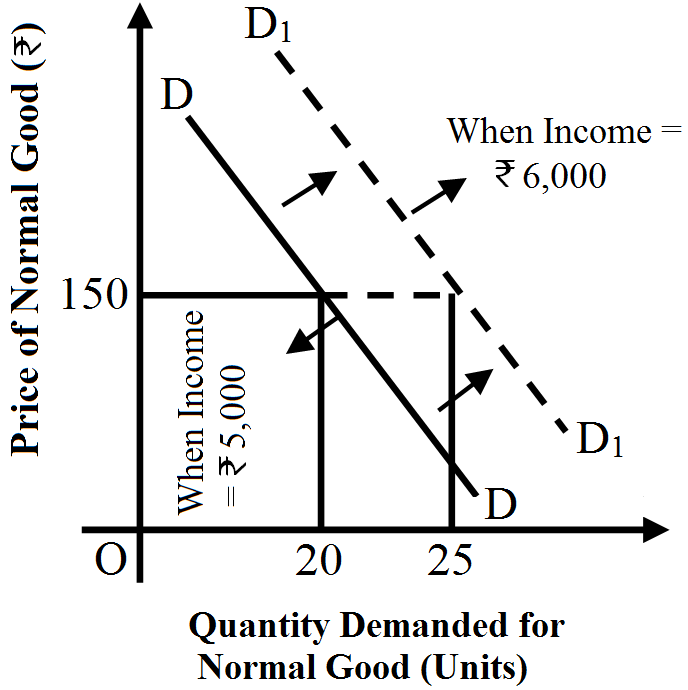
Normal goods are those in which quantity demanded varies directly with the consumer's income.
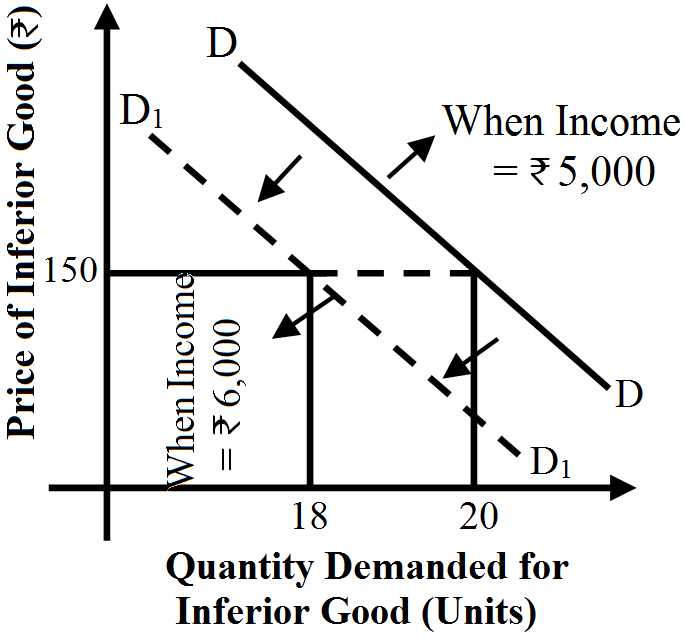
Inferior goods are those in which quantity demanded varies inversely with a consumer's income.
2.
Schedule
Price of Normal good
Quantity demanded of normal good when Income of a consumer is ₹ 5000
Quantity demanded good of normal good when Income of a consumer
is ₹ 6000
Price of Inferior Goods
Quantity demanded of Inferior goods when Income of a consumer is ₹ 5000
Quantity demanded of Inferior goods when Income of a consumer is ₹ 6000
3.
 
150
20
25
150
20
18
4.
 
170
18
21
170
18
15
5.
Curve

Need a full question paper?

Generate a complete, print-ready paper with questions like this in minutes — across 16+ boards, with answer keys.

Start Generating Free

Similar questions

When price of a good is Rs. 7 per unit a consumer buys 12 units. When price falls to Rs. 6 per unit he spends Rs. 72 on the good. Calculate price elasticity of demand by using the percentage method. Comment on the likely shape of demand curve based on this measure of elasticity.
A consumer spends ₹ $80$ on a commodity when price is ₹ $1$ per unit. If the price increases by ₹ $1$, his expenditure becomes ₹ $96$. Comment on $PED.$
Price elasticity of demand for a product is ‘unity'. A household buys $25$ units of this product at the price of ₹ $5$ per unit. If the price of product rises by ₹ $1,$ how much quantity of the product will the household buy?
Due to $10$ percent rise in the price of a commodity, its quantity supplied rises from $400$ units to $450$ units. Calculate its price elasticity of supply.
PED of X is known to be thrice that of Y. If price of the commodity X increases by 20% and price of the commodity Y decreases by 40%, calculate percentage change in demand in both the cases.
Differentiate between decrease in supply and contraction in supply (decrease in quantity supplied).
When price of a good falls by 10 percent, its quantity demanded rises from 40 units to 50 units. Calculate price elasticity of demand by the percentage method.
Compute the total revenue, marginal revenue and average revenue schedules in the following table. Market price of each unit of the good is Rs. $10$.
Quantity Sold
TR
MR
AR
0
1
2
3
4
5
6


Complete the following table:
Price

(Rs.)
Output

(Units)
Total Revenue

(Rs.)
Marginal Revenue

(Rs.)
- 1 6 -
4 - - 2
- 3 6 -
1 - - - 2
Explain the meaning of marginal rate of substitution. Why does it diminish as one good is substituted for the other Explain.