Question
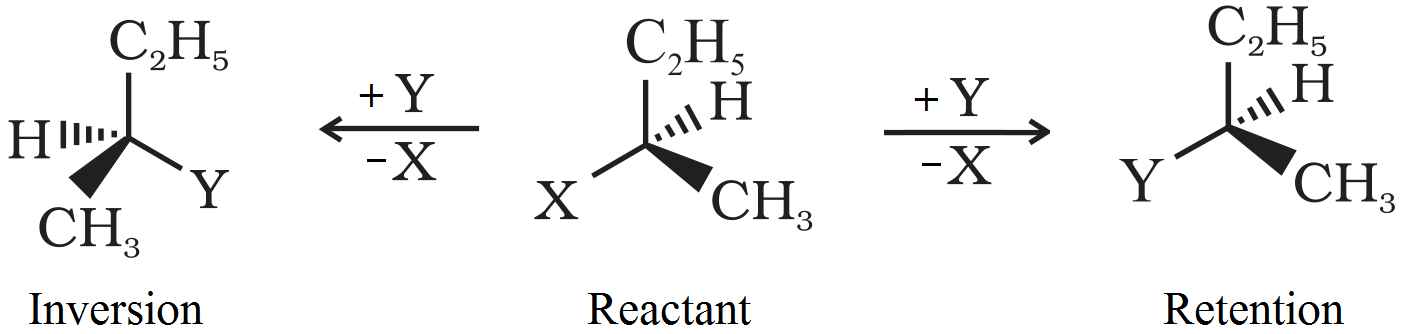
Differentiate between retention and inversion.
Answer


If the relative configuration of the atoms/ groups around a chiral centre in an optically active molecule remains the same before and after the reaction, the reaction is said to proceed with retention of configuration. On the other hand, if the relative configuration of the atoms/ groups around a stereocentre in the product is opposite to that in the reactant, the reaction is said to proceed with inversion of configuration.
For example,

Need a full question paper?

Generate a complete, print-ready paper with questions like this in minutes — across 16+ boards, with answer keys.

Start Generating Free

Similar questions

Give reasons for the following:
  1. Acetylation of aniline reduces its activation effect.
  2. $CH_3NH_2$ is more basic than $C_6H_5NH_2.$
  3. Although $-NH_2$ is o/p directing group, yet aniline on nitration gives a significant amount of m-nitroaniline.
  1. The cell in which the following reaction occurs:
$2 Fe^{3+} (aq) + 2 I^- (aq) \longrightarrow 2 Fe^{2+}(aq) + I2 (s)$

has $\text{E}^0_{\text{cell}}$ = 0·236 V at 298 K. Calculate the standard Gibbs energy of the cell reaction. (Given : $1 F = 96,500 C mol^{-1}$)
  1. How many electrons flow through a metallic wire if a current of 0·5 A is passed for 2 hours? (Given : $1 F = 96,500 C mol^{-1}$)
What type of substances would make better permanent magnets, ferromagnetic or ferrimagnetic. Justify your answer.
Match the type of unit cell given in Column I with the features given in Column II.
  Column I   Column I
(i)
Primitive cubic unit cell
(a)
Each of the three perpendicular edges compulsorily have the different edge length i.e; a ≠ b ≠ c.
(ii)
Body centred cubic unit cell
(b)
Number of atoms per unit cell is one.
(iii)
Face centred cubic unit cell
(c)
Each of the three perpendicular edges compulsorily have the same edge length i.e.; a = b = c
(iv)
End centred orthorhombic unit cell
(d)
In addition to the contribution from the corner atoms the number of atoms present in a unit cell is one.
 
 
(e)
In addition to the contribution from the corner atoms the number of atoms present in a unit cell is three.
$100$ mg of a protein is dissolved in just enough water to make $10.0$ mL of solution. If this solution has an osmotic pressure of $13.3$ mm Hg at $25^{\circ} \mathrm{C}$, what is the molar mass of the protein? $\left(\mathrm{R}=0.0821 \mathrm{~L} \mathrm{~atm} \mathrm{~mol}{ }^{-1} \mathrm{~K}^{-1}\right.$ and $760$ mm Hg $=1 \mathrm{~atm}$.
Explain Van't Hoff factor.
How would you account for the following:
  1. The transition elements have high enthalpies of atomisation.
  2. The transition metals and their compounds are found to be good catalysts in many processes.
  1. What is the basis of formation of the spectro-chemical series?
  2. Draw the structures of geometrical isomers of the following coordination complexes:
$[Co(NH_3)_3Cl_3]$ and $ [CoCl_2(en)_2]^+.$
(en = ethylenediamine and atomic number of Co is 27).
$3.9\ g$ of benzoic acid dissolved in $49\ g$ of benzene shows a depression in freezing point of $1.62\ K.$ Calculate the van't Hoff factor and predict the nature of solute (associated or dissociated).
$($Given: Molar mass of benzoic acid $=122 \mathrm{~g} \mathrm{~mol}^{-1}, \mathrm{~K}_{\mathrm{f}}$ for benzene $=4.9 \mathrm{~K} \mathrm{~kg} \mathrm{~mol}^{-1} )$
The halides of transition elements become more covalent with increasing oxidation state of the metal.