Question
Differentiate between substitute goods and complementary goods.

Answer

S. No. Basis Substitute Goods Complementary Goods
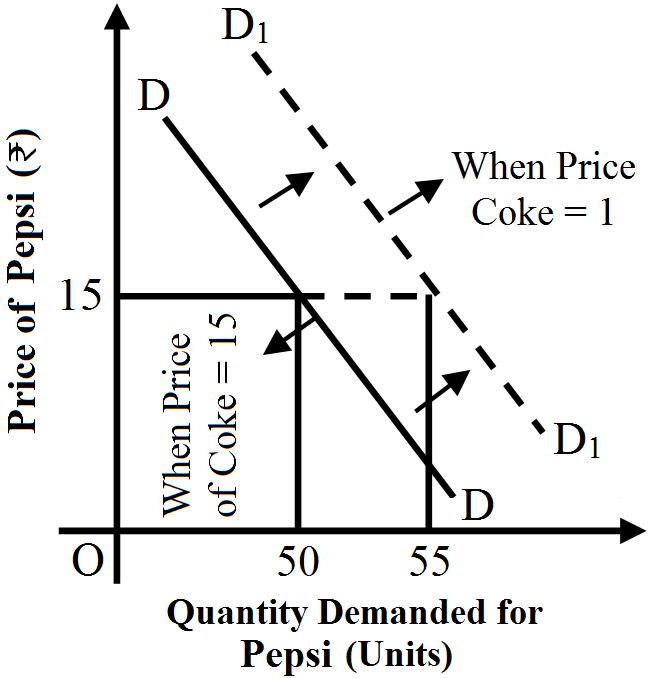
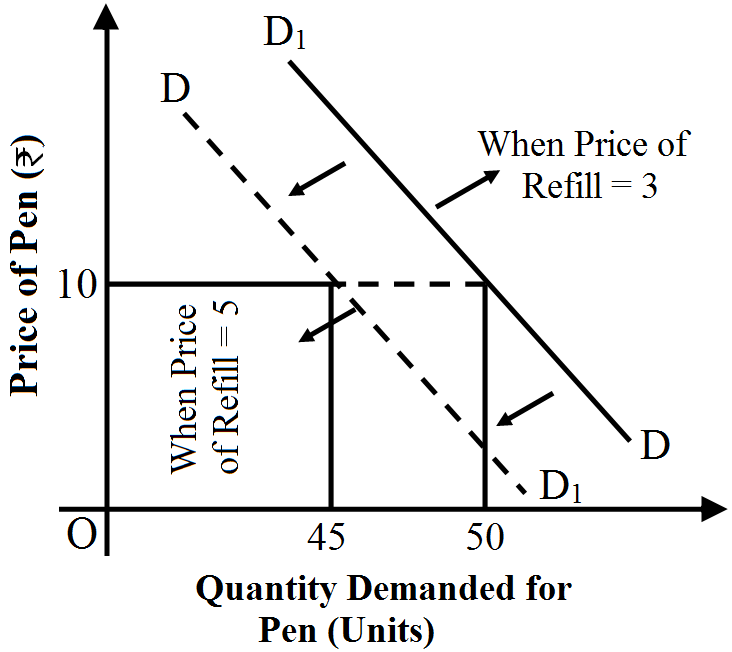
1. Meaning Substitute goods are those which can be used in place of another goods and gives the same satisfaction to a consumer. Complementary goods are those which are useless in the absence of other goods and which are demanded jointly.
2. Relation ship There always exists a positive direct relationship between the price of substitute goods and demand of a given commodity. There always exists an inverse ship relationship between the price of complementary goods and demand of given commodity.
3. Schedule
Price of Pepsi Given Commodity] * [per unit] Quantity Demanded of Pepsi when Price of Coke Substitute good) = * 15 [units] Quantity Demanded of Pepsi when Price of Coke [Substitute good) = * 18 [units]
15 50 55
16 45 52
Price of Pen [Given Commodity] * [per unit] Quantity Demanded of Pen when Price of Refill [Complimentary good] = *3 [units] Quantity Demanded of Pen when Price of Refill [Complimentary good) = *5 [units]
10 50 45
20 45 40
4. Diagram

Need a full question paper?

Generate a complete, print-ready paper with questions like this in minutes — across 16+ boards, with answer keys.

Start Generating Free

Similar questions

What is the value of the MR when the demand curve is elastic?
What type of production function is this in which only one input is increased and others kept constant? State the behaviour of total product in this production function.
Explain any two causes of a leftward shift of supply curve.
OR
What is decrease in supply? Explain any two factors that can cause it.
Distinguish between individual’s demand and market demand. Name the factors affecting demand for a good by an individual.
Explain the meaning of change in quantity demanded. How does it affect demand curve?
Complete the following table:
Output

(Units)
Total variable cost

(Rs.)
Average variable cost

(Rs.)
Marginal cost

(Rs.)
1 - 12 -
2 20 - -
- - 10 10
4 40 - -
A consumer buys $20$ units of a good at a price of ₹ $5$ per unit. He incurs an expenditure of ₹ $120$ when he buys $24$ units. Calculate price elasticity of demand using the percentage method. Comment upon the likely shape of demand curve based on this information.
Complete the following table:
Output (Units) Price (₹) Total Revenue (₹) Marginal Revenue (₹)
4 9 36 -
5 - - 4
6 - 42 -
7 6 - -
8 - 40 -
Calculate Total Variable Cost and Total Cost from the following cost schedule of a firm whose Fixed Costs are 10:
Output (unit) 1 2 3 4
Marginal Cost (MC) (₹) 6 5 4 6
A consumer spends Rs. 1000 on a good priced at Rs. 8 per unit. When price rises by 25 percent, the consumer continues to spend Rs. 1000 on the good. Calculate price elasticity of demand by percentage method.