Question
Differentiate between wind pollinated and insect pollinated flowers.

Answer

S. No. Wind Pollinated Insect Pollinated
1. Wind pollinated flowers don not have nectar Insect Pollinated flowers are rich in nectar to attract insects.
2. The petals are dull and does not attract the insects The petals of these flowers are very colorful and attractive.
3. They dont have any scent The scent of these flowers are another factor that attracts insects.
4. The pollen grains are non-sticky, light The pollen grains are sticky.
5. Stigma is feathery, to catch the pollen grain Stigma is non-feathery and sticky.

Need a full question paper?

Generate a complete, print-ready paper with questions like this in minutes — across 16+ boards, with answer keys.

Start Generating Free

Similar questions

  1. Mention the specific geographical region where these organisms are found.
  2. Name and explain the phenomenon that has resulted in the evolution of such diverse species in the region.
  3. Explain giving reasons the existence of placental wolf and Tasmanian wolf sharing the same habitat.

Classify the following composition of blood plasma given below as per Column ‘A’ and complete Column ‘B’. Select from the given options
(i) Serum albumin
(ii) Bicarbonates
(iii) Urea
(iv) Sulphates of sodium
(v) Fibrinogen
(vi) Uric acid

Column AColumn B
(1) Plasma proteins————
(2) Nitrogenous waste————
(3) Inorganic salts————
Many secondary metabolites of plants have medicinal properties. It is their misuse that creates problems. Justify the statement with an example.
Answer the following questions:
Mention any four strategies adopted by flowering plants to prevent self-pollination.
How is puberty attained in females? Will a female normally remain reproductively capable even after age 50? If not then what makes her incapable?
Explain the mode of infection and cause of elephantiasis.
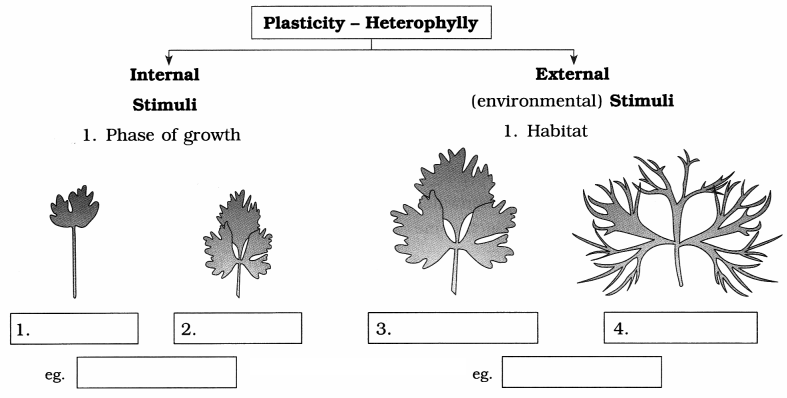
Complete the chart of plasticity.
Image
Study the age pyramids ‘A’, ‘B’ and ‘C’ of the human population given below and answer the questions that follow:
  1. Identify pyramids ‘B’ and ‘C’.
  2. Write the basis on which the above pyramids are plotted.
  1. Give the scientific name of the soil bacterium which produces crystal (Cry) proteins.
  2. How are these proteins useful in agriculture?
  3. What do the differently written terms ‘Cry’ and ‘cry’ represent respectively?
  1. Expand MTP.
  2. Give two situations, when MTP is advised.
  3. Write when amniocentesis and MTP can be misused.