Question
Differentiate between: Reactants and products.

Answer

Reactants
  1. The substances that react with one another are called reactants.
  2. Reactants are written on the left hand side of equation.
Products
  1. The new substances formed are called products.
  2. Products are written on the right hand side of equation.

Need a full question paper?

Generate a complete, print-ready paper with questions like this in minutes — across 16+ boards, with answer keys.
Start Generating Free

Similar questions

Explain the term ‘mixture’. Differentiate between homogenous $\&$ heterogenous mixtures. State why brass is considered as a homogenous mixture while a mixture of iron $\&$ sulphur – heterogenous. Give an example of two liquids which form $–$
$(a)$ homogenous
$(b)$ heterogenous $–$ mixtures.
State the information provided by a chemical equation.Chemical equations suffer from a number of limitations. State the main limitations of a chemical equation.
With reference to the discovery of the structure of an atom, explain in brief $-$ William Crookes experiment for the discovery of cathode rays, followed by $-$ J.J. Thomsons experiment pertaining to the constituents of the cathode rays. State which sub$-$atomic particle was discovered from his experiment.
Draw a labelled schematic diagram representing the terms $(a)$ to $(e)$ involved in the inter-conversion of matter.
Potassium chloride is added to water and stirred. A salt solution is obtained which is then boiled leaving behind a residue.
$(a)$ Is the above change physical or chemical
$(b)$ Name the residue which remains behind after the salt solution is boiled.
$(c)$ Is the change reversible or not reversible.
$(d)$ Are the composition and properties of the original substance altered.
$(e)$ Give a reason why the above experimentation would not be possible, if calcium carbonate is taken, in place of potassium chloride.
Name four types of coal with percentage of carbon present in each,with uses.
What are $(i)$ positive catalysts and $(ii)$ negative catalysts? Support your answer with one example for each of them.
What are the limitations of a chemical equation ?
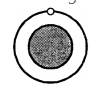
The diagram represents an isotope of hydrogen $[H],$ Answer the following:
Image
At. no.$ = 1$
Mass no. $= 1$
$1.$ Are isotopes atoms of the same element or different elements.
$2.$ Do isotopes have the same atomic number or the same mass number.
$3.$ If an isotope of $‘H’$ has mass no.$ = 2$, how many electrons does it have.
$4.$ If an isotope of ‘$H’$ has mass no. $= 3$, how many neutrons does it have.
$5.$ Which sub$-$atomic particles in the $3$ isotopes of $‘H’ $ are the same.
State what is meant by ‘reactivity series of metals’. With reference to $- (a)$ Water $(b)$ Acids explain with suitable examples how the reactivity of the metals could be differentiated.