Question
Differentiate the following functions with respect to x:
$10^{\log\sin\text{x}}$

Answer

Let $\text{y}=10^{\log\sin\text{x}}\ .....(\text{i})$
Taking log on both sides,
$\log\text{y}=\log10^{\log\sin\text{x}}$
$\Rightarrow\log\text{y}=\log\sin\text{x}\log10$
Differentiating with respect to x,
$\Rightarrow\frac{1}{\text{y}}\frac{\text{dy}}{\text{dx}}=\log10\frac{\text{d}}{\text{dx}}\log\sin\text{x}$
$\Rightarrow\frac{1}{\text{y}}\frac{\text{dy}}{\text{dx}}=\log10\frac{1}{\sin\text{x}}\frac{\text{d}}{\text{dx}}(\sin\text{x})$
$\Rightarrow\frac{1}{\text{y}}\frac{\text{dy}}{\text{dx}}=\log10\Big(\frac{1}{\sin\text{x}}\Big)(\cos\text{x})$
$\Rightarrow\frac{\text{dy}}{\text{dx}}=\text{y}\big[\log10\times\cot\text{x}\big]$
$\Rightarrow\frac{\text{dy}}{\text{dx}}=10^{\log\sin\text{x}}\times\log10\times\cot\text{x}$
[Using equation (i)]

Need a full question paper?

Generate a complete, print-ready paper with questions like this in minutes — across 16+ boards, with answer keys.
Start Generating Free

Similar questions

Differentiate the functions given in Exercise:
$\Big(\text{x}+\frac{1}{\text{x}}\Big)^\text{x}+\text{x}^{\Big(1+\frac{1}{\text{x}}\Big)}$
Show that the vectors $\vec{\text{a}},\ \vec{\text{b}},\ \vec{\text{c}}$ given by $\vec{\text{a}}=\hat{\text{i}}+2\hat{\text{j}}+3\hat{\text{k}},\ \vec{\text{b}}=2\hat{\text{i}}+\hat{\text{j}}+3\hat{\text{k}}$ and $\vec{\text{c}}=\hat{\text{i}}+\hat{\text{j}}+\hat{\text{k}}$ are non-coplanar. Express vector $\vec{\text{d}}=2\hat{\text{i}}-\hat{\text{j}}-3\hat{\text{k}}$ as a linear combination of the vectors $\vec{\text{a}},\ \vec{\text{b}}\text{ and }\vec{\text{c}}$.
Find the equation of the plane through the line of intersection of the planes $x + y + z = 1$ and $2x + 3y + 4z = 5$ which is perpendicular to the plane $x - y + z = 0.$
Using the properties of determinants$: \begin{vmatrix}\text{x}+4&\text{x}&\text{x}\\\text{x}&\text{x}+4&\text{x}\\\text{x}&\text{x}&\text{x}+4\end{vmatrix}$
Differentiate $\text{w.r.t. x}$ the function in Exercise :
$\text{x}^\text{x}+\text{x}^\text{a}+\text{a}^\text{x}+\text{a}^\text{a},$ for some fixed $a > 0$ and $x > 0$
Solve the following differential equation:
$(1+\text{x}^2)\frac{\text{dy}}{\text{dx}}+\text{y}=\text{e}^{\tan^{-1}\text{x}}$
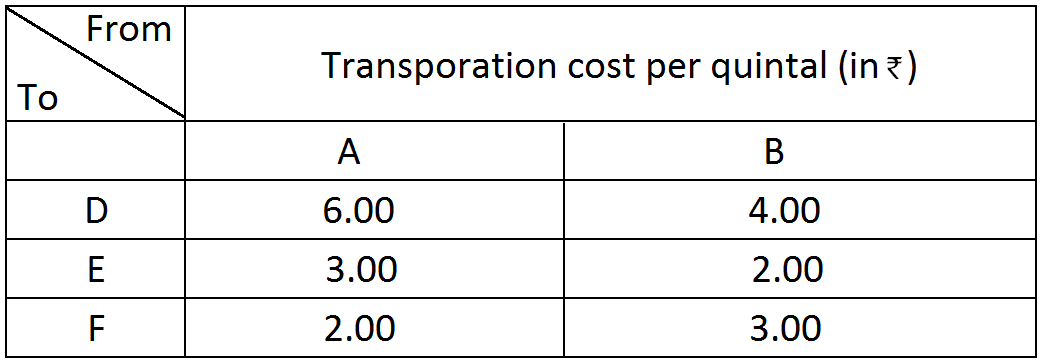
Tow godowns$, A$ and $B,$ have grain storage capacity of $100$ quintals and $50$ quintals respectively. They supply to $3$ ration shops$, D, E$ and $F,$ whose requirements are $60, 50$ and $40$ quintals respectively. The cost of transportation per quintal from the godowns to the shops are given in the following table:

How should the supplies be transported in order that the transportation cost is minimum? 
Evaluate the following integrals:$\int\frac{1}{\cos\text{x}+\text{cosec x}}\text{dx}$
Find $\frac{\text{dy}}{\text{dx}},$ when
$\text{x}=\text{a}(\cos\theta+\theta\sin\theta)$ and $\text{y}=\text{a}(\sin\theta-\theta\sin\theta-\theta\cos\theta)$
If a, b, c are the langths of sides, BC, CA and AB of a triangle ABC, prove that $\overrightarrow{\text{BC}}+\overrightarrow{\text{CA}}+\overrightarrow{\text{AB}}=\vec{\text{0}}$ and deduce that $\frac{\text{a}}{\sin\text{A}}=\frac{\text{b}}{\sin\text{B}}=\frac{\text{c}}{\sin\text{C}}.$