Question
Differentiate the following functions with respect to x:
$(1+\cos\text{x})^\text{x}$

Answer

Let $\text{y}=(1+\cos\text{x})^\text{x}\ .....(\text{i})$
Taking log on both the sides,
$\log\text{y}=\log(1+\cos\text{x})^\text{x}$
$\log\text{y}=\text{x}\log(1-\cos\text{x})$
Differentiating with respect to x,
$\frac{1}{\text{y}}\frac{\text{dy}}{\text{dx}}=\text{x}\frac{\text{d}}{\text{dx}}\log(1+\cos\text{x})+\log(1+\cos\text{x})\frac{\text{d}}{\text{dx}}(\text{x})$
$\Rightarrow\frac{1}{\text{y}}\frac{\text{dy}}{\text{dx}}=\text{x}\frac{1}{(1+\cos\text{x})}\frac{\text{d}}{\text{dx}}(1+\cos\text{x})+\log(1+\cos\text{x})(1)$
$\Rightarrow\frac{1}{\text{y}}\frac{\text{dy}}{\text{dx}}=\frac{\text{x}}{(1+\cos\text{x})}(0-\sin\text{x})+\log(1+\cos\text{x})$
$\Rightarrow\frac{1}{\text{y}}\frac{\text{dy}}{\text{dx}}=\log(1+\cos\text{x})-\frac{\text{x}\sin\text{x}}{(1+\cos\text{x})}$
$\Rightarrow\frac{\text{dy}}{\text{dx}}=\text{y}\Big[\log(1+\cos\text{x})-\frac{\text{x}\sin\text{x}}{(1+\cos\text{x})}\Big]$
$\Rightarrow\frac{\text{dy}}{\text{dx}}=(1+\cos\text{x})^\text{x}\Big[\log(1+\cos\text{x})-\frac{\text{x}\sin\text{x}}{(1+\cos\text{x})}\Big]$
[Using equation (i)]

Need a full question paper?

Generate a complete, print-ready paper with questions like this in minutes — across 16+ boards, with answer keys.
Start Generating Free

Similar questions

Differentiate the following functions from first principles:
$\log\cos\text{x}$
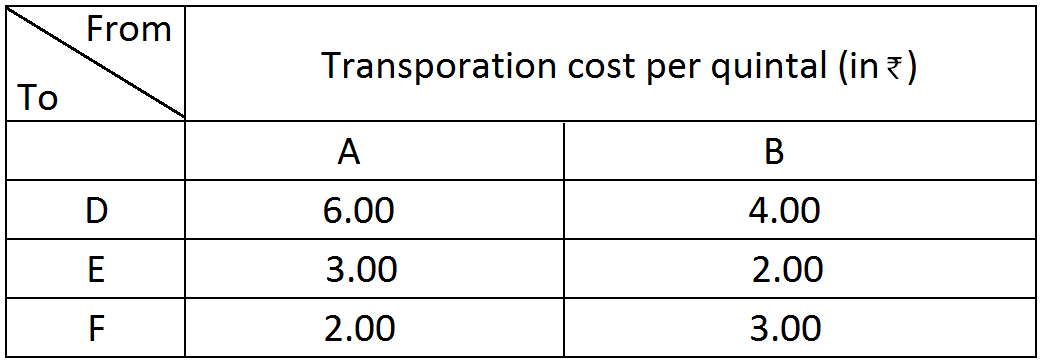
Tow godowns, A and B, have grain storage capacity of 100 quintals and 50 quintals respectively. They supply to 3 ration shops, D, E and F, whose requirements are 60, 50 and 40 quintals respectively. The cost of transportation per quintal from the godowns to the shops are given in the following table:

How should the supplies be transported in order that the transportation cost is minimum?
Find $\lambda$ for which the points A(3, 2, 1), B(4, $\lambda$, 5), C(4, 2, -2) and D(6, 5, -1) are coplanar.
Using Lagrange's mean value theorem, prove that
$(\text{b}-\text{a})\sec^2\text{a}<\tan\text{b}-\tan\text{a}<(\text{b}-\text{a})\sec^2\text{b}$
where $0<\text{a}<\text{b}<\frac{\pi}{2}.$
David wants to invest at most $Rs. 12,000$ in Bonds $A$ and $B$. According to the rule, he has to invest at least $Rs. 2,000$ in Bond A and at least $Rs. 4,000$ in Bond $B.$ If the rates of interest on Bonds $A$ and $B$ respectively are $8\%$ and $10\%$ per annum, formulate the problem as L.P.P. and solve it graphically for maximum interest. Also determine the maximum interest received in a year.
Find the equations of the planes parallel to the plane x - 2y + 2z - 3 = 0 and which are at a unit distance from the point (1, 1, 1).
An airline agrees to charter planes for a group. The group needs at least 160 first class seats and at least 300 tourist class seats. The airline must use at least two of its model 314 planes which have 20 first class and 30 tourist class seats. The airline will also use some of its model 535 planes which have 20 first class seats and 60 tourist class seats. Each flight of a model 314 plane costs the company Rs 100,000 and each flight of a model 535 plane costs Rs 150,000. How many of each type of plane should be used to minimize the flight cost? Formulate this as a LPP.
If a relation R is defined on the set Z of integers as follows: $(a, b) \in R ⇔ a^2 + b^2 = 25$. Then, domain (R) is:
Determine the product and use it to $\begin{bmatrix} -4 & 4 & 4 \\ -7 & 1 & 3 \\ 5 & -3 & -1 \end{bmatrix} \begin{bmatrix} 1 & -1 & 1 \\ 1 & -2 & -2 \\ 2 & 1 & 3 \end{bmatrix}$solve the system of equations x – y + z = 4, x – 2y – 2z = 9, 2x + y + 3z = 1.
Find the particular solution of the differential equation $\frac{\text{dy}}{\text{dx}}=-4\text{xy}^2$ given that $\text{y}=1.$ when $\text{x}=0.$