Question
Differentiate the following functions with respect to x:
$\log_7(2\text{x}-3)$

Answer

Let, $\text{y}=\log_7(2\text{x}-3)$
$\Rightarrow\ \text{y}=\frac{\log(2\text{x}-3)}{\log_7}\ \Big[\text{Since}, \log^\text{b}_\text{a}=\frac{\log\text{b}}{\log\text{a}}\Big]$
Differentiate it with respect to x,
$\frac{\text{dy}}{\text{dx}}=\frac{1}{\log7}\frac{\text{d}}{\text{dx}}\big(\log(2\text{x}-3)\big)$
$=\frac{1}{\log7}\times\frac{1}{(2\text{x}-3)}\frac{\text{d}}{\text{dx}}(2\text{x}-3)$
[Using chain rule]
$=\frac{2}{(2\text{x}-3)\log7}$
Hence, $\frac{\text{d}}{\text{dx}}(\log_7(2\text{x}-3))=\frac{2}{(2\text{x}-3)\log7}$

Need a full question paper?

Generate a complete, print-ready paper with questions like this in minutes — across 16+ boards, with answer keys.
Start Generating Free

Similar questions

If $A$ and $B$ are square matrices of the same order such that $AB = BA,$ then prove by induction that $AB’’ = B’’A.$ Further prove that $(AB)’’ = A’’B’’$ for all $n \Rightarrow N.$
Find the points o local maxima or local minima, if any, of the following functions, using the first derivatives test. Also, find the local maximum or local minimum values, as the case may be:
$\text{f}(\text{x})=\text{x}\sqrt{1-\text{x}}, \text{x}\geq0$ 
Evalute the following integrals:
$\int\frac{\cot\text{x}}{\log\sin\text{x}}\text{dx}$
Evaluate the following integrals:
$\int^\limits1_{-1}5\text{x}^4\sqrt{\text{x}^5+1}\text{ dx}$
Evaluate the following intregals:
$\int\frac{1}{\cos2\text{x}+3\sin^2\text{x}}\ \text{dx}$
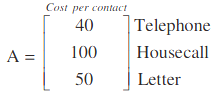
In a legislative assembly election, a political group hired a public relations firm to promote its candidate in three ways: telephone, house calls, and letters. The cost per contact (in paise) is given in matrix A as

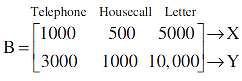
The number of contacts of each type made in two cities X and Y is given by

Find the total amount spent by the group in the two cities X and Y.
Show that the following planes are at right angles.
$\vec{\text{r}}\cdot(2\hat{\text{i}}-\hat{\text{j}}+\hat{\text{k}})=5$ and $\vec{\text{r}}\cdot(-\hat{\text{i}}-\hat{\text{j}}+\hat{\text{k}})=3$
Evaluate the following integrals:
$\int_{4}^\limits{12}\text{x}(\text{x}-4)^{\frac{1}{3}}\text{dx}$
Two numbers are selected at random (without replacement) from the first six positive integers. Let X denote the larger of the two numbers obtained. Find E(X).
The mathematics department has 8 graduate assistants who are assigned to the same office. Each assistant is just as likely to study at home as in office. How many desks must there be in the office so that each assistant has a desk at least 90% of the time?