Question
Differentiate the following functions with respect to x:
$\sin^{-1}\Big(\frac{1}{\sqrt{1+\text{x}^2}}\Big)$

Answer

Let $\text{f(x)}=\sin^{-1}\Big(\frac{2^{\text{x}+1}}{1+4^\text{x}}\Big)$

To find the domain, we need to find all x such that

$-1\leq\frac{2^{\text{x}+1}}{1+4^\text{x}}\leq1$

Since the quantity in the middle is always psitive, we need to find all x such that $\frac{2^{\text{x}+1}}{1+4^\text{x}}\leq1$

i.e. all x such that $2^{\text{x}+1}\leq1+4^\text{x}$

We may req. write as $2\leq\frac{1}{2^\text{x}}+2^\text{x},$ which is true for all x

Hence, the function is defined at all real numbers.

Putting $2^\text{x}=\tan\theta$

$\text{f(x)}=\sin^{-1}\Big(\frac{2^{\text{x}+1}}{1+4^\text{x}}\Big)=\sin^{-1}\Big(\frac{2^\text{x}.2}{1+(2^\text{x})^2}\Big)$

$=\sin^{-1}\Big[\frac{2\tan\theta}{1+\tan^2\theta}\Big]=\sin^{-1}(\sin2\theta)=2\theta=2\tan^{-1}(2^\text{x})$

Thus, $\text{f(x)}=2\frac{1}{1+(2^\text{x})^2}\frac{\text{d}}{\text{dx}}(2^\text{x})$

$=\frac{2}{1+4^\text{x}}(2^\text{x})\log2=\frac{2^{\text{x}+1}\log2}{1+4^\text{x}}$

Need a full question paper?

Generate a complete, print-ready paper with questions like this in minutes — across 16+ boards, with answer keys.
Start Generating Free

Similar questions

Find a particular solution of the differential equation $\left(1+ x ^2\right) d y+2 x y d x=\cot x d x$, given that $y=0$ of $x=\frac{\pi}{2}$.
If $\text{A}=\begin{bmatrix}2&3\\1&2\end{bmatrix}$ and $\text{I}=\begin{bmatrix}1&0\\0&1\end{bmatrix},$ then find $\lambda,\mu$ so that $\text{A}^2=\lambda\text{A}+\mu\text{I}$
Arun and Tarun appeared for an interview for two vacancies. The probability of Arun's selection is $\frac{1}{4}$ and that to Tarun's rejection is $\frac{2}{3}$. Find the probability that at least one of them will be selected.
Find the equation of the line passing through the points $\hat{\text{i}}+\hat{\text{j}}-3\hat{\text{k}}$ and perpendicular to the lines $\vec{\text{r}}=\hat{\text{i}}+\lambda\big(2\hat{\text{i}}+\hat{\text{j}}-3\hat{\text{k}}\big)$ and $\vec{\text{r}}=\big(2\hat{\text{i}}+\hat{\text{j}}-\hat{\text{k}}\big)+\mu\big(\hat{\text{i}}+\hat{\text{j}}+\hat{\text{k}}\big).$
An experiment succeeds twice as often as it fails. Find the probability that in the next 6 trials there will be at least 4 successes.
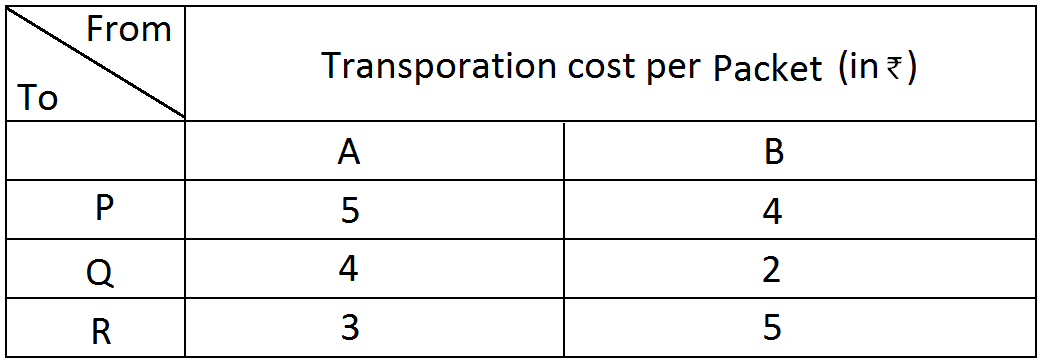
A medical company has factories at two places, A and B. From these places, supply is made to each of its three agencies situated at P, Q and R. The monthly requirements of the agencies are respectively 40, 40 and 50 packets of the medicines, while the production capacity of the factories, A and B, are 60 and 70 packets respectively. The transportation cost per packet from the factories to the agencies are given below:

How many packets from each factory be transported to each agency so that the cost of transportation is minimum? Also find the minimum cost?

If $\text{A}=\begin{vmatrix}2&5\\2&1\end{vmatrix}$ and $\text{B}=\begin{vmatrix}4&-3\\2&5\end{vmatrix},$ verify that |AB| = |A| |B|.
Compute the adjoint of the following matrices:

$\begin{bmatrix}2 & 0 & -1 \\5 & 1 & 0 \\ 1 & 1 & 3 \end{bmatrix}$

Verify that (adj A)A = |A| I = A (adj A) for the above matrices.

Find $\frac{\text{dy}}{\text{dx}}$ in the following cases:
y3 - 3xy2 = x3 + 3x2y
Evaluate the following definite integrals:
$\int_{0}^\limits{\frac{\pi}{2}}\cos^4\text{x}\text{ dx}$