Question
Differentiate the function $x^{x \cos x}+\frac{x^{2}+1}{x^{2}-1} w.r.t. x.$

Answer

Given: $\mathrm{x}^{\mathrm{x} \cos \mathrm{x}}+\frac{\mathrm{x}^{2}+1}{\mathrm{x}^{2}-1}$
Let $y=x^{x \cos x}+\frac{x^{2}+1}{x^{2}-1}$
Let $y = u + v$
$\Rightarrow u = x^{xcos x}$ and $v = \frac{x^{2}+1}{x^{2}-1}$
For, $\mathrm{u}=\mathrm{x}^{\mathrm{x} \cos x}$
Taking $\log$ on both sides, we get
$\log u=\log {x} ^{x \cos x}$
$\Rightarrow \log u=x \cdot \cos x \cdot \log x$
Now, differentiate both sides with respect to $x$
$\frac{d}{d x}(\log u)=\frac{d}{d x}[x \cdot \cos x \cdot \log x]$
$\Rightarrow \frac{1}{\mathrm{u}} \frac{\mathrm{du}}{\mathrm{dx}}=\cos \mathrm{x} \cdot \log \mathrm{x} \cdot \frac{\mathrm{d}}{\mathrm{dx}}(\mathrm{x})+\mathrm{x} \cdot \log \mathrm{x} \cdot \frac{\mathrm{d}}{\mathrm{dx}}(\cos \mathrm{x})+\mathrm{x} \cdot \cos \mathrm{x} \cdot \frac{\mathrm{d}}{\mathrm{dx}} \log \mathrm{x}$
$\Rightarrow \frac{\mathrm{d} \mathrm{u}}{\mathrm{dx}}=\mathrm{u}\left[\cos \mathrm{x} . \log \mathrm{x}+\mathrm{x} \cdot \log \mathrm{x}(-\sin \mathrm{x})+\mathrm{x} \cdot \cos \mathrm{x} \cdot\left(\frac{1}{\mathrm{x}}\right)\right]$
$\Rightarrow \frac{d u}{d x}=x^{x \cos x}[\cos x \cdot \log x-x \cdot \log x \cdot \sin x+\cos x]$
$\Rightarrow \frac{d u}{d x}=x^{x \cos x}[\cos x(1+\log x)-x \cdot \log x \cdot \sin x]$
For $, v = \frac{x^{2}+1}{x^{2}-1}$
Takinglog on both sides, we get
$\log \mathrm{v}=\log \left(\frac{\mathrm{x}^{2}+1}{\mathrm{x}^{2}-1}\right)$
$\Rightarrow \log v=\log \left(x^{2}+1\right)-\log \left(x^{2}-1\right)$
Now, differentiate both sides with respect to $x$
$\frac{d}{d x}(\log v)=\frac{d}{d x}\left[\log \left(x^{2}+1\right)-\log \left(x^{2}-1\right)\right]$
$\Rightarrow \frac{1}{\mathrm{v}} \frac{\mathrm{d} \mathrm{v}}{\mathrm{dx}}=\frac{1}{\mathrm{x}^{2}+1} \cdot \frac{\mathrm{d}}{\mathrm{dx}}\left(\mathrm{x}^{2}\right)-\frac{1}{\mathrm{x}^{2}-1} \cdot \frac{\mathrm{d}}{\mathrm{dx}}\left(\mathrm{x}^{2}\right)$
$\Rightarrow \frac{d v}{d x}=v \cdot\left[\frac{1}{x^{2}+1} \cdot(2 x)-\frac{1}{x^{2}-1} \cdot(2 x)\right]$
$\Rightarrow \frac{d v}{d x}=\left(\frac{x^{2}+1}{x^{2}-1}\right) \cdot\left[\frac{2 x\left(x^{2}-1\right)-2 x\left(x^{2}+1\right)}{\left(x^{2}+1\right)\left(x^{2}-1\right)}\right]$
$\Rightarrow \frac{d v}{d x}=\left(\frac{x^{2}+1}{x^{2}-1}\right) \cdot\left[\frac{-4 x}{\left(x^{2}+1\right)\left(x^{2}-1\right)}\right]$
$\Rightarrow \frac{d v}{d x}=\left[\frac{-4 x}{\left(x^{2}-1\right)^{2}}\right]$
Because $, y = u + v$
$\Rightarrow \frac{d y}{d x}=\frac{d u}{d x}+\frac{d v}{d x}$
$\Rightarrow \frac{d y}{d x}=x^{x \cos x}[\cos x(1+\log x)-x \cdot \log x \cdot \sin x]-\left[\frac{4 x}{\left(x^{2}-1\right)^{2}}\right]$

Need a full question paper?

Generate a complete, print-ready paper with questions like this in minutes — across 16+ boards, with answer keys.
Start Generating Free

Similar questions

Evaluate the following definite integral as limit of sum:
$\int\limits^{\text{b}}_{\text{a}}\text{x dx}$
Evaluate the following integrals:
$\int\frac{2\text{x}}{\text{x}^3-1}\ \text{dx}$
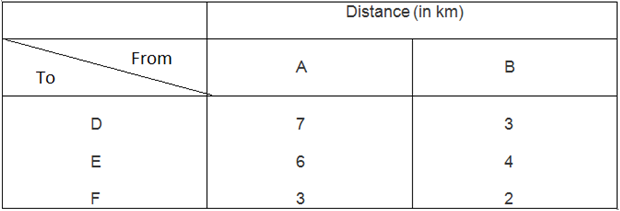
An oil company has two depots$, A$ and $B,$ with capacities of $7000$ litres and $4000$ litres respectively. The company is to supply oil to three petrol pumps, $\text{D, E, F}$ whose requirements are $4500, 3000$ and $3500$ litres respectively. The distance $($in $\ km)$ between the depots and petrol pumps is given in the following table:

Assuming that the transportation cost per km is $Rs. 1.00$ per litre, how should the delivery be scheduled in order that the transportation cost is minimum?
A card is drawn from a pack of 52 cards so that each card is equally likely to be selected. In which of the following cases are the events A and B independent?
A = the card drawn is black,
B = the card drawn is a king.
Evaluate the following integrals:
$\int^\limits{(\pi)^\frac{2}{3}}_{0}\sqrt{\text{x}}\cos^2\text{x}^{\frac{3}{2}}\text{ dx}$
Solve the following differential equation
$\frac{\text{dy}}{\text{dx}}=(\text{e}^\text{x}+1)\text{y}$
Solve the following initial value problems: $\text{y}'+\text{y}=\text{e}^{\text{x}},\text{ y}(0)=\frac{1}{2}$
If $\text{A}=\begin{bmatrix}1&2&0\\-2&-1&-2\\0&-1&1\end{bmatrix}$, find $A^{-1},$ solve the system of linear equations $x - 2y = 10, 2x - y - z = 8, -2y + z = 7$
Find the vector equations of the following planes in scalar product form $(\vec{\text{r}}\cdot\vec{\text{n}}=\text{d}):$
$\vec{\text{r}}=(2\hat{\text{i}}-\hat{\text{k}})+\lambda\hat{\text{i}}+\mu(\hat{\text{i}}-2\hat{\text{j}}-\hat{\text{k}})$
Differentiate the following functions with respect to x:
$\frac{\text{x}^2(1-\text{x}^2)}{\cos2\text{x}}$