Question
Differentiate w.r.t. x the function in Exercise:
$\text{x}^{\text{x}^2-3}+(\text{x}-3)^{\text{x}^2},$  for x > 3

Answer

Let y = $\text{x}^{\text{x}^{2-3}}+(\text{x}-3)^{\text{x}^2}$
Also, let $\text{u}=\text{x}^{\text{x}^2-3}\text{ and v}=(\text{x}-3)^{\text{x}^2}$
$\therefore\ \text{y}=\text{u}+\text{v}$
Differentiating both sides with respect to x, we obtain
$\frac{\text{dy}}{\text{dx}}=\frac{\text{du}}{\text{dx}}+\frac{\text{dv}}{\text{dx}}\ \ \dots(1)$
$\text{u}=\text{x}^{\text{x}^2-3}$
$\therefore\ \log\text{u}=\log(\text{x}^{\text{x}^2-3})$
$\log\text{u}=(\text{x}^2-3)\log\text{x}$
Differentiating with respect to x, we obtain
$\frac{1}{\text{u}}\cdot\frac{\text{du}}{\text{dx}}=\log\text{x}.\frac{\text{d}}{\text{dx}}(\text{x}^2-3)+(\text{x}^2+3)\cdot\frac{\text{d}}{\text{dx}}(\log\text{x})$
$\Rightarrow\ \frac{1}{\text{u}}\frac{\text{du}}{\text{dx}}=\log\text{x}\cdot2\text{x}+(\text{x}^2-3)\cdot\frac{1}{\text{x}}$
$\Rightarrow\ \frac{\text{du}}{\text{dx}}=\text{x}^{\text{x}^2-3}\cdot\Bigg[\frac{\text{x}^2-3}{\text{x}}+2\text{x}\log\text{x}\Bigg]$
Also,
$\text{v}=(\text{x}-3)^{\text{x}^2}$
$\therefore\ \log\text{v}=\log(\text{x}-3)^{\text{x}^2}$
$\Rightarrow\ \log\text{v}=\text{x}^2\log(\text{x}-3)$
Differentiating both sides with respect to x, we obtain
$\frac{1}{\text{v}}\cdot\frac{\text{dv}}{\text{dx}}=\log(\text{x}-3)\cdot\frac{\text{d}}{\text{dx}}(\text{x}^2)+\text{x}^2\cdot\frac{\text{d}}{\text{dx}}\big[\log(\text{x}-3)\big]$
$\Rightarrow\ \frac{1}{\text{v}}\frac{\text{dv}}{\text{dx}}=\log(\text{x}-3)\cdot2\text{x}+\text{x}^2\cdot\frac{1}{\text{x}-3}\cdot\frac{\text{d}}{\text{dx}}(\text{x}-3)$
$\Rightarrow\ \frac{\text{dv}}{\text{dx}}=\text{v}\Bigg[2\text{x}\log(\text{x}-3)+\frac{\text{x}^2}{\text{x}-3}\cdot1\Bigg]$
$\Rightarrow\ \frac{\text{dv}}{\text{dx}}=(\text{x}-3)^{\text{x}^2}\Bigg[\frac{\text{x}^2}{\text{x}-3}+2\text{x}\log(\text{x}-3)\Bigg]$
Substituting the expressions of $\frac{\text{du}}{\text{dx}}\text{ and }\frac{\text{dv}}{\text{dx}}$ in equation (1), we obtain
$\frac{\text{dy}}{\text{dx}}=\text{x}^{\text{x}^2-3}\Bigg[\frac{\text{x}^2-3}{\text{x}}+2\text{x}\text{logx}\Bigg]+(\text{x}-3)^\text{x} \Bigg[\frac{\text{x}^{\text{x}}}{\text{x}-3}+2\text{x}\log(\text{x}-3)\Bigg]$

Need a full question paper?

Generate a complete, print-ready paper with questions like this in minutes — across 16+ boards, with answer keys.
Start Generating Free

Similar questions

Finde the value of a and b, if the function f(x) defined by $\text{f(x)}\begin{cases}\text{x}^2+3\text{x}+\text{a}, &\text{x}\leq1\\\text{bx}+2, & \text{x}>1\end{cases}$is differentiable at x = 1.
If $\text{f(x)}=\begin{cases}\text{ax}^2-\text{b}, & \text{if |x|}<1\\\frac{1}{|\text{x}|}, & \text{if |x|}\geq1\end{cases}$ is differentiable at x = 1, find a, b.
Solve the following differential equation:
$\text{x}\frac{\text{dy}}{\text{dx}}-\text{y}=(\text{x}-1)\text{e}^{\text{x}}$
Solve the following differential equations $\frac{\text{dy}}{\text{dx}}=\frac{2\text{x}(\log\text{x}+1)}{\sin\text{y+y}\cos\text{y}},$ given that $\text{y}=0,$ when $\text{x}=1.$
If A and B are two independent events such that $\text{P}(\overline{\text{A}}\cap\text{B})=\frac{2}{15}$ and $\text{P}(\text{A}\cap\overline{\text{B}})=\frac{1}{6}$, then find P(B).
Verify Rolle's theorem of the following function on the indicated interval
$\text{f}(\text{x})=\log(\text{x}^2+2)-\log3\text{ on }[-1,1]$
Find the angle between the lines whose direction ratios are proportional to a, b, c and b - c, c - a, a - b.
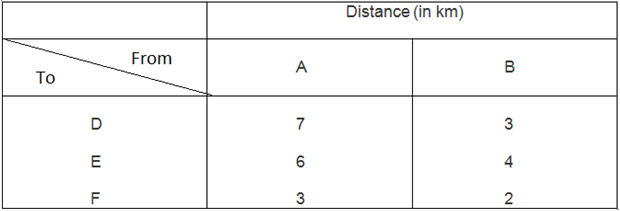
An oil company has two depots, A and B, with capacities of 7000 litres and 4000 litres respectively. The company is to supply oil to three petrol pumps, D, E, F whose requirements are 4500, 3000 and 3500 litres respectively. The distance (in km) between the depots and petrol pumps is given in the following table:

Assuming that the transportation cost per km is Rs. 1.00 per litre, how should the delivery be scheduled in order that the transportation cost is minimum?
Suppose 5% of men and 0.25% of women have grey hair. Agrey haired person is selected at random.What is the probability of this person being male? Assume that there are equal number of males and females.
Find the equations of the tangent and the normal to the following curves at the indicated points.
$\text{x}=\theta+\sin\theta,\text{y}=1+\cos\theta\text{ at }\theta=\frac{\pi}{2}$