MCQ
Diffusion current in a $p-n$ junction is greater than the drift current in magnitude:
  • If the junction is forward$-$biased.
  • B
    If the junction is reverse$-$biased.
  • C
    If the junction is unbiased.
  • D
    In no case.

Answer

Correct option: A.
If the junction is forward$-$biased.
In the forward biassing of a $p−n$ junction, the positive terminal of the battery is connected to the $p$ side of the $p−n$ junction and the negative terminal of the battery is connected to the n side of the $p−n$ junction. As a result, electrons in the n side of the $p−n$ junction are repelled by the negative terminal of the battery and move to the $p$ side, where the positive terminal of the battery attracts the electrons. Similarly, holes from the $p$ side of the $p−n$ junction are repelled by the positive terminal of the battery and move to the nside, where the negative terminal of the battery attracts the holes. Thus, they give diffusion current across the $p−n$ junction.
In case of reverse biassing, no conduction takes place across the junction because of the diffusion of majority carriers. Hence, there is no diffusion current.
If the junction is unbiased, then diffusion current is initially maximum. But at equilibrium, diffusion current becomes equal to drift current.

Need a full question paper?

Generate a complete, print-ready paper with questions like this in minutes — across 16+ boards, with answer keys.
Start Generating Free

Similar questions

If a number of sine waves with modulation indices $n_1, n_2, n_3 ........$ modulate a carrier wave, then total modulation index $(n)$ of the wave is
In a Fresnel’s diffraction arrangement, the screen is at a distance of $2$ meter from a circular aperture. It is found that for light of wavelengths ${\lambda _1}$ and ${\lambda _2},$ the radius of $4^{th}$ zone for ${\lambda _1}$ coincides with the radius of $5^{th}$ zone for ${\lambda _2}.$ Then the ratio ${\lambda _1}:{\lambda _2}$ is
What amount of heat will be generated in a coil of resistance $R$ due to a charge $q$ passing through it if the current in the coil decreases to zero uniformly during a time interval $\Delta t$
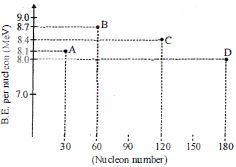
The positions of four different nuclei in the binding energy curve are shown in figure. The process that might not proceed spontaneously is
A symmetric double convex lens is cut in two equal parts by a plane perpendicular to the principal axis. If the power of the original lens was $4 D$, the power of a cut lens will be
A particle of mass $\mathrm{m}$ and charge $\mathrm{q}$ is released from rest in a uniform electric field. If there is no other force on the particle, the dependence of its speed $v$ on the distance $x$ travelled by it is correctly given by (graphs are schematic and not drawn to scale)
A convex lens forms a real image of an object for its two different positions on a screen. If height of the image in both the cases be 8 cm and 2 cm, then height of the object is
 
A galvanometer of resistance $20 \,\Omega$ is to be converted into an ammeter of range $1\, A$. If a current of $1\, mA$ produces full scale deflection, the shunt required for the purpose is ................ $\Omega $
A particle of mass $1\, mg$ has the same wavelength as an electron moving with a velocity of $3\times10^6\, m\,s^{-1}$. The velocity of the particle is (Mass of electron $= 9.1 \times 10^{-31}\, kg$ )
In ${88^{Ra}}^{226}$ nucleus, there are