MCQ
Dimension of $\frac{1}{\mu_0 \varepsilon_0}$ should be equal to
  • A
    $T ^2 / L ^2$
  • B
    $L / T$
  • $L ^2 / T ^2$
  • D
    $T / L$

Answer

Correct option: C.
$L ^2 / T ^2$
c
$\frac{1}{\mu_0 \in_0}=c^2 \Rightarrow\left[\frac{1}{\mu_0 \in_0}\right]=\left[ c ^2\right]=\left[ L ^2 T ^{-2}\right]$

Need a full question paper?

Generate a complete, print-ready paper with questions like this in minutes — across 16+ boards, with answer keys.
Start Generating Free

Similar questions

A wire of length $L$ and radius $r$ is clamped rigidly at one end. When the other end of the wire is pulled by a force $F$, its length increases by $5\,cm$. Another wire of the same material of length $4 L$ and radius $4\,r$ is pulled by a force $4\,F$ under same conditions. The increase in length of this wire is $....cm$.
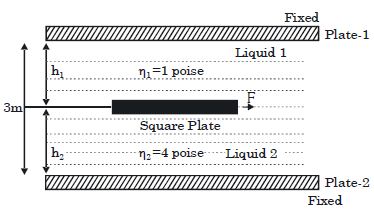
A thin square plate of side $2\ m$ is moving at the interface of two very viscous liquids of viscosities ${\eta _1} = 1$ poise and ${\eta _2} = 4$ poise respectively as shown in the figure. Assume a linear velocity distribution in each fluid. The liquids are contained between two fixed plates. $h_1 + h_2 = 3\ m$ . A force $F$ is required to move the square plate with uniform velocity $10\ m/s$ horizontally then the value of minimum applied force will be ........ $N$
A particle is moving along a straight line parallel to $x-$ axis with constant velocity. Its angular momentum about the origin
The image formed by a concave mirror:
A pressure-pump has a horizontal tube of cross-sectional area $10\,cm ^{2}$ for the outflow of water at a speed of $20\,m / s$. The force exerted on the vertical wall just in front of the tube which stops water horizontally flowing out of the tube, is $...N$ [given : density of water $=1000\,kg / m ^{3}$ ]
On a new scale of temperature (which is linear) and called the $W\, scale$, the freezing and boiling points of water are $39\,^oW$ and $239\,^oW$ respectively. What will be th temperature on the new scale, corresponding to a temperature of $39\,^oC$ on the Celsius scale ....... $^oW$ ?
A particle of mass $200 \,g$ is moving in a circle of radius $2 \,m$. The particle is just 'looping the loop'. The speed of the particle and the tension in the string at highest point of the circular path are $\left(g=10 \,ms ^{-2}\right)$
When a tuning fork vibrates, the waves produced in the fork are
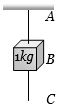
A mass of $1 kg$ is suspended by a string $A$. Another string $C$ is connected to its lower end (see figure). If a sudden jerk is given to $C$, then
A capillary tube made of glass of radius $0.15\, mm$ is dipped vertically in a beaker filled with methylene iodide (surface tension $=0.05\, Nm ^{-1},$ density $\left.=667\, kg m ^{-3}\right)$ which rises to height $h$ in the tube. It is observed that the two tangents drawn from liquid-glass interfaces (from opp. sides of the capillary) make an angle of $60^{\circ}$ with one another. Then $h$ is close to $......m$

$\left(g=10\, ms ^{-2}\right)$