MCQ
Dimension of Planck's constant is :
- ✓$ ML^{2}T^{-1} $
- B$ ML^{2}T^{-2} $
- C$ MLT^{-1} $
- D$ MLT^{-2} $
Generate a complete, print-ready paper with questions like this in minutes — across 16+ boards, with answer keys.
A current carrying solenoid is approaching a conducting loop as shown in the figure. The direction of induced current as observed by an observer on the other side of the loop will be
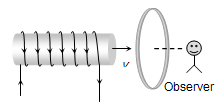
|
(a) Anticlockwise |
(b) Clockwise |
(c) East |
(d) West |
To deposit one litre of hydrogen at 22.4 atmosphere from acidulaled water, the quantity of electricity that must pass through is
|
(a) 1 coulomb |
(b) 22.4 coulomb
|
(c) 96500 coulomb |
(d) 193000 coulomb |
In the case of bar magnet, lines of magnetic induction
|
(a) Start from the north pole and end at the south pole |
|
(b) Run continuously through the bar and outside |
|
(c) Emerge in circular paths from the middle of the bar |
|
(d) Are produced only at the north pole like rays of light from a bulb |
A achromatic combination is made with a lens of focal length f and dispersive power ω with a lens having dispersive power of 2ω. The focal length of second will be
|
(a) 2f |
(b) f/2 |
(c) -f/2 |
(d) – 2 f |
In a wire of circular cross-section with radius r, free electrons travel with a drift velocity V when a current I flows through the wire. What is the current in another wire of half the radius and of the same material when the drift velocity is 2V
|
(a) 2I |
(b) I |
(c) I/2 |
(d) I/4 |