MCQ
Dimensional formula of heat energy is
  • $M{L^2}{T^{ - 2}}$
  • B
    $ML{T^{ - 1}}$
  • C
    ${M^0}{L^0}{T^{ - 2}}$
  • D
    None of these

Answer

Correct option: A.
$M{L^2}{T^{ - 2}}$
a
(a) $Q = [M{L^2}{T^{ - 2}}]$ (All energies have same dimension)

Need a full question paper?

Generate a complete, print-ready paper with questions like this in minutes — across 16+ boards, with answer keys.

Start Generating Free

Similar questions

$A$ rod of weight $w$ is supported by two parallel knife edges $A$ and $B$ and is in equilibrium in a horizontal position. The knives are at a distance $d$ from each other. The centre of mass of the rod is at a distance $x$ from $A$.
The height attained by a ball after 3 rebounds on falling from a height of h on floor having coefficient of restitution e is:
A particle performs simple harmonic motion with a period of $2$ second. The time taken by the particle to cover a displacement equal to half of its amplitude from the mean position is $\frac{1}{ a } s .$ The value of $'a'$ to the nearest integer is.........
$8$ mercury drops coalesce to form one mercury drop, the energy changes by a factor of
The unit vector parallel to the resultant of the vectors $\vec A = 4\hat i + 3\hat j + 6\hat k$ and $\vec B = - \hat i + 3\hat j - 8\hat k$ is
A player throws a ball that reaches to the another player in $4\,s$. If the height of each player is $1.5\,m$, the maximum height attained by the ball from the ground level is  .......... $m$
For a projectile, the ratio of maximum height reached to the square of flight time is ($g = 10 ms^{-2}$)
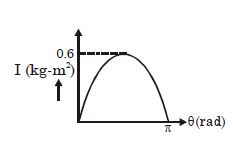
Figure shows the variation of the moment of inertia of a uniform rod, about an axis passing through its centre and inclined at an angle $\theta$ to the length. The moment of inertia of the rod about an axis passing through one of its ends and making an angle $\theta  = \frac{\pi }{3}$ will be ........ $ kg-m^2$.
A circular disc of mass $10 \;kg$ is suspended by a wire attached to its centre. The wire is twisted by rotating the disc and released. The period of torsional oscillations is found to be $1.5 \;s$. The radius of the disc is $15\; cm .$ Determine the torsional spring constant of the wire in $N\;m\;rad^{-1}$. (Torsional spring constant $\alpha$ is defined by the relation $J=-\alpha \theta,$ where $J$ is the restoring couple and $\theta$ the angle of twist).