MCQ
Dimensional formula of resistivity is
  • A
    $\left[ {M{L^2}{A^{ - 2}}{T^{ - 3}}} \right]$
  • $\left[ {M{L^3}{A^{ - 2}}{T^{ - 3}}} \right]$
  • C
    $\left[ {ML{A^{ - 2}}{T^{ - 3}}} \right]$
  • D
    $\left[ {M{L^3}{A^{ - 1}}{T^{ - 3}}} \right]$

Answer

Correct option: B.
$\left[ {M{L^3}{A^{ - 2}}{T^{ - 3}}} \right]$
b
Resistivity $=\frac{\text { Resistance } \times \text { Area }}{\text { Length }}$

$=\frac{M L^{2} T^{-3} A^{-2} \times L^{2}}{L}=\left[M L^{3} T^{-3} A^{-2}\right]$

Need a full question paper?

Generate a complete, print-ready paper with questions like this in minutes — across 16+ boards, with answer keys.
Start Generating Free

Similar questions

If a man increase his speed by $2 \,m/s$ , his K.E. is doubled, the original speed of the man is
A bus travelling the first one-third distance at a speed of $10\; km/h$, the next one-third at $20\; km/h$ and at last one-third at $60\; km/h$. The average speed of the bus is ........ $km/h$
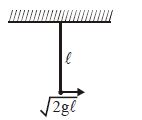
A simple pendulum having length $\ell $ is having speed  $\sqrt {2g\ell }$ at bottom most point of its trajectory. Its motion will be
If the overbridge is concave instead of being convex, the thrust on the road at the lowest position will be
A solid metallic sphere of radius $r$ is allowed to fall freely through air. If the frictional resistance due to air is proportional to the cross-sectional area and to the square of the velocity, then the terminal velocity of the sphere is proportional to which of the following?
Three particles start from origin at the same time with a velocity $2ms^{-1}$ along positive $x-$axis the second with a velocity $6ms^{-1}$ aling negative $y -$ axis. Find the velocity of the third particle along $x = y$ line so that the three particles may always lie in a straight line:
The energy density in the electric field created by a point charge falls off with the distance from the point charge as:
A wire elongates by 1.0mm when a load W is hung from it. If this wire goes over a a pulley and two weights W each are hung at the two ends, he eloogation of he wire will be:
Sound waves travel fastest in
When a ceiling fan is switched on, it makes $10$ rotations in first $3\,seconds,$ How many rotations will it make in the next $3\,seconds.$ (Assume uniform angular acceleration)