MCQ
Dimensions of charge are
  • A
    ${M^0}{L^0}{T^{ - 1}}{A^{ - 1}}$
  • B
    $MLT{A^{ - 1}}$
  • C
    ${T^{ - 1}}A$
  • $TA$

Answer

Correct option: D.
$TA$
d
(d) Charge = Current $ \times $ Time =$[AT]$

Need a full question paper?

Generate a complete, print-ready paper with questions like this in minutes — across 16+ boards, with answer keys.
Start Generating Free

Similar questions

Consider the following two statements:
  1. Kirchhoff's junction law follows from conservation of charge.
  2. Kirchhoff's loop law follows from conservative nature of electric field.
  1. Both A and B are correct.
  2. A is correct but B is wrong.
  3. B is correct but A is wrong.
  4. Both A and B are wrong.
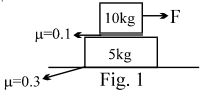
The acceleration of $10\, kg$ block when $F = 30\,N$ ........ $m/s^2$
A surface of area $S$ is placed perpendicular to the direction of travel of a plane wave. The energy per unit time intercepted by the surface is $E$ when the amplitude of the wave is $A$ . The area of the surface is reduced to $\frac{1}{2} \ S$ and the amplitude of the wave is increased to $2\ A$ . What is the energy per unit time intercepted by this smaller surface?
A standing wave pattern is formed on a string. One of the waves is given by equation ${y_1} = a\,\cos \,\left( {\omega t - kx + \pi /3} \right)$ then the equation of the other wave such that at $x = 0$ a node is formed
 
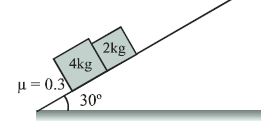
Two blocks, $4\, kg$ and $2\, kg$ are sliding down an inclined plane as shown in figure. The acceleration of $2\, kg$ block is ........ $m/s^2$ 
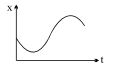
The graph of position $x$ versus time $t$ represents the motion of a particle. If $b$ and $c$ are both positive constants, which of the following expressions best describes the acceleration $a$ of the particle?
A stationary body of mass $m$ gets exploded in $3$ parts having mass in the ratio of $1 : 3 : 3$. Its two fractions having equal mass moving at right angle to each other with velocity of $15\,m/sec$. Then the velocity of the third body is
On a linear temperature scale $Y$, water freezes at $- 160^o\, Y$ and boils at $- 50^o\, Y$. On this $Y$ scale , a temperature of $340\, K$ would be read as........ $^oY$  ( water freezes at $273\, K$ and boils at $373\, K$)
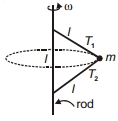
In the figure, a ball of mass $m$ is tied with two strings of equal length as shown. If the rod is rotated with angular velocity $\omega$, then
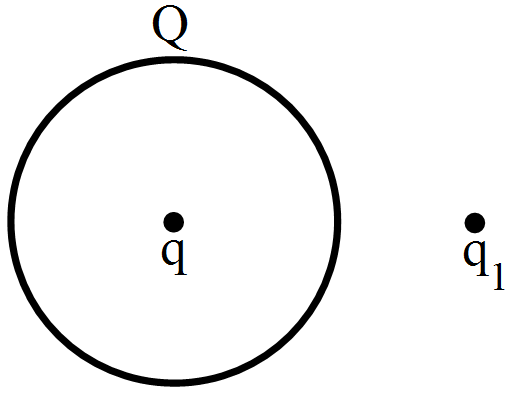
A thin, metallic spherical shell contains a charge Q on it. A point charge q is placed at the centre of the shell and another charge q1 is placed outside it as shown in figure. All the three charges are positive. The force on the charge at the centre is:

  1. Towards left.
  2. Towards right.
  3. Upward.
  4. Zero.