MCQ
Dimensions of stress are 
  • $\left[ M L ^{-1} T ^{-2}\right]$
  • B
    $\left[ M L T ^{-2}\right]$
  • C
    $\left[ M L ^{2} T ^{-2}\right]$
  • D
    $\left[ M L ^{0} T ^{-2}\right]$

Answer

Correct option: A.
$\left[ M L ^{-1} T ^{-2}\right]$
a
stress $=\frac{\text { Force }}{\text { Area }}$

$=\frac{M^{1} L^{1} T^{-2}}{L^{2}}$

stress $= M ^{1} L ^{-1} T ^{-2}$

Need a full question paper?

Generate a complete, print-ready paper with questions like this in minutes — across 16+ boards, with answer keys.
Start Generating Free

Similar questions

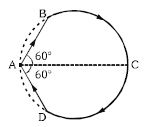
Consider a circle of radius $42\  cm$. An insect crawls with uniform speed of $1.3\  cm/s$ along the chord $AB$ then along the circular arc $BCD$ to reach point $D$ and then following cord $DA$ to reach finally $A$. Time spend by the insect to crawl from $A$ to $A$ is closest to    ......... $\sec$
Which of the following pairs of physical quantities are not analogous to each other in case of translatory motion and rotational motion,
stone is tied to one end of a string $50\, cm$ long is whirled in a horizontal circle with a constant speed. If the stone makes $10$ revolutions in $20\, s$, what is the magnitude of acceleration of the stone ......... $cm/s^2$
A particle moves from the point $\left( {2.0\hat i + 4.0\hat j} \right)\,m$, at $t = 0$ with an initial velocity $\left( {5.0\hat i + 4.0\hat j} \right)\,m{s^{ - 1  }}$. It is acted upon by a constant force which produces a constant acceleration $\left( {4.0\hat i + 4.0\hat j} \right)\,m{s^{ - 2}}$. What is the distance of the particle from the origin at time $2\,s$
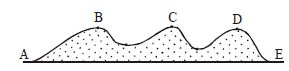
A particle of mass $3\  kg$ is taken through $ABCDE$ from $A$ to $E$ height of $B$ , $C$ & $D$ are $5\ m$ , $4\ m$ , $6\ m$ respectively. Total path length $20\ m$ $AE$ = $10\ m$ , $\mu $ = $0.6$ . ........ $J$ work done to slowly move mass from $A$ to $E$ . ( $g = 10 \ m/s^2$ )
Two waves are simultaneously passing through a string and their equations are :

${y}_{1}={A}_{1} \sin {k}({x}-v {t}), {y}_{2}={A}_{2} \sin {k}\left({x}-{vt}+{x}_{0}\right) .$ Given amplitudes ${A}_{1}=12\, {mm}$ and ${A}_{2}=5\, {mm}$ ${x}_{0}=3.5\, {cm}$ and wave number ${k}=6.28\, {cm}^{-1}$. The amplitude of resulting wave will be $......\,{mm}$

The graph between $\sqrt E $and $\frac{1}{p}$ is ($E$=kinetic energy and $p = $ momentum)
A box weighs $196 \;\mathrm{N}$ on a spring balance at the north pole. Its weight recorded on the same balance if it is shifted to the equator is close to ....... $N$

(Take $\mathrm{g}=10\; \mathrm{ms}^{-2}$ at the north pole and the radius of the earth $=6400\; \mathrm{km}$)

Absolute zero $(0\, K)$ is that temperature at which
If the liquid neither rises nor falls in a capillary tube, then angle of contact is