MCQ
Dipole moment of $NF_3$ is smaller than
  • $NH_3$
  • B
    $CO_2$
  • C
    $BF_3$
  • D
    $CCl_4$

Answer

Correct option: A.
$NH_3$
a
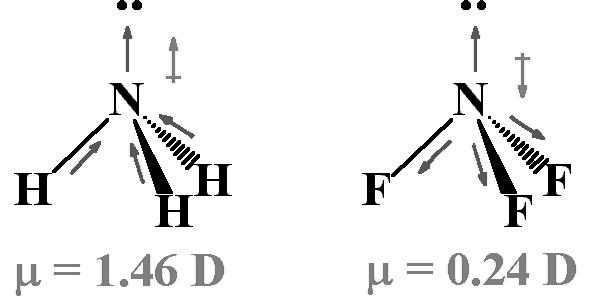
Both the molecules have a pyramidal shape with a lone pair of electrons on the nitrogen atom. Although fluorine is more electronegative than nitrogen, the resultant dipole moment of $\mathrm{NH}_{3}\left(4.90 \times 10^{-30} \mathrm{CM}\right)$ is greater than that of $\mathrm{NF}_{3}\left(0.8 \times 10^{-30} \mathrm{Cm}\right)$

This is because in case of $\mathrm{NH}_{3}$ the orbital dipole due to lone pair is in the same direction as the

resultant dipole moment of the $\mathrm{N}-\mathrm{H}$ bonds. Whereas in $\mathrm{NF}_{3}$ the orbital dipole is in the direction opposite to the resultant dipole moment of

the three $N$ - F bonds. The orbital dipole because of the lone pair decreases the effect of the

resultant $N$ - F bond moments, which results in the low dipole moment of $\mathrm{NF}_{3}$.
Need a full question paper?

Generate a complete, print-ready paper with questions like this in minutes — across 16+ boards, with answer keys.

Start Generating Free

Similar questions

Incorrect order of radius is
In an element going away from nucleus, the energy of particle
${E^o}$ values of $M{g^{2 + }}/Mg$ is $ - 2.37\,V$, of $Z{n^{2 + }}/Zn$ is $ - 0.76\,V$ and $F{e^{2 + }}/Fe$ is $ - 0.44\,V$. Which of the following statements is correct
A solution containing $N{a_2}C{O_3}$ and $NaOH$ requires $300\, ml$ of $0.1\, N$ $HCl$ using phenolpthalein as an indicator. Methyl orange is then added to the above titrated solution when a further $25\, ml$ of $0.2\, N$ $HCl$ is required. The amount of $NaOH$ present in solution is  ................. $\mathrm{g}$  $(NaOH = 40,\,N{a_2}C{O_3} = 106)$
A certain electronic transition from an excited state to the ground state of the $H_2$ atom  in one or more steps gives rise to four lines in the ultra violet region of the  spectrum, how many lines does this transition produce in the infrared region of the spectrum :-
Match the element in column $I$ with that in column $II$.

Column - $I$ Column - $II$
$(a)$ Copper $(i)$ Non-metal
$(b)$ Fluorine $(ii)$ Transition Metal
$(c)$ Silicon $(iii)$ Lanthanoid
$(d)$ Cerium $(iv)$ Metalloid

Identify the correct match:

$(X){{C}_{4}}{{H}_{7}}OCl\xrightarrow{N{{H}_{3}}}{{C}_{4}}{{H}_{9}}ON\xrightarrow[KOH]{B{{r}_{2}}}C{{H}_{3}}C{{H}_{2}}C{{H}_{2}}N{{H}_{2}};$ Compound $(X)$ is
Bromination of alkanes involves
In a chemical equilibrium $A + B$ $\rightleftharpoons$ $C + D$, when one mole each of the two reactants are mixed, $0.6 $ mole each of the products are formed. The equilibrium constant calculated is
At higher altitude, boiling point of water is $95\,^oC$. The amount of $NaCl$ added to $1\, kg$ of water $(K_b = 0.52\, K\, mol^{-1}\,kg)$ in order to raise the boiling point of solution to $100\,^oC$ (assuming $90\%$ ionisation of $NaCl$) .......... $g$