MCQ
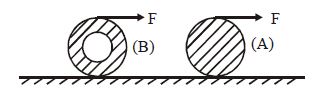
Disc $A$ and disc $B$ with a hole have equal mass and radius and a string is wrapped around them as shown. Equal force $F$ is applied on the string of each body. Friction is sufficient for rolling. After time $t$ velocity of $A$ is $v_A$ and that of $B$ is $v_B$ and kinetic energy $k_A$ & $k_B$ , then
  • A
    $v_A = v_B$
  • B
    $v_A < v_B$
  • $k_A > k_B$
  • D
    $k_A < k_B$

Answer

Correct option: C.
$k_A > k_B$
c
$\mathrm{F}+\mathrm{f}=\mathrm{ma}$

$(\mathrm{F}-\mathrm{f}) \mathrm{R}=\mathrm{I} \alpha$

$\Rightarrow \mathrm{F}-\mathrm{f}=\frac{\mathrm{I} \alpha}{\mathrm{R}^{2}} \quad(\mathrm{a}=\mathrm{R} \alpha)$

adding

$F=\left(m+\frac{I}{R^{2}}\right) \frac{a}{2}$

$v=0+a t$

$=\frac{2 \mathrm{F}}{\left(\mathrm{m}+\frac{\mathrm{I}}{\mathrm{R}^{2}}\right)} \mathrm{t}$

$\mathrm{K.E.}=\frac{1}{2} \mathrm{mv}^{2}+\frac{1}{2} \mathrm{I} \omega^{2}$

$=\frac{1}{2} \mathrm{V}^{2}\left(\mathrm{m}+\frac{\mathrm{I}}{\mathrm{R}^{2}}\right), \omega=\frac{\mathrm{V}}{\mathrm{R}}$

$=\frac{1}{2}\left(\frac{2 \mathrm{Ft}}{\mathrm{m}+\frac{\mathrm{I}}{\mathrm{R}^{2}}}\right)^{2}\left(\mathrm{m}+\frac{\mathrm{I}}{\mathrm{R}^{2}}\right)=\frac{2 \mathrm{F}^{2} \mathrm{t}^{2}}{\left(\mathrm{m}+\frac{\mathrm{I}}{\mathrm{R}^{2}}\right)}$

$\mathrm{Also}, \mathrm{I}_{\mathrm{B}}>\mathrm{I}_{\mathrm{A}}$                    

Need a full question paper?

Generate a complete, print-ready paper with questions like this in minutes — across 16+ boards, with answer keys.

Start Generating Free

Similar questions

$4$ moles of an ideal gas is at $0°C.$ At constant pressure it is heated to double its volume, then its final temperature will be ...... $^oC$
The temperature of equal masses of three different liquids $A, B$ and $C$ are $12°C, 19°C$ and $28°C$ respectively. The temperature when $A$ and $B$ are mixed is $16°C$ and when $B$ and $C$ are mixed is $23°C$. The temperature when $A$ and $C$ are mixed is........ $^oC$
The $P.E.$ of a certain spring when stretched from natural length through a distance $0.3\, m$ is $10\, J$. The amount of work in joule that must be done on this spring to stretch it through an additional distance $0.15\, m$ will be ................ $\mathrm{J}$
Three discs $A, B$ and $C$ having radii $2\; m, 4\;m,$ and $6 \;m$, respectively are coated with carbon black on their outer surfaces. The wavelengths corresponding to maximum intensity are $300\; nm, 400\; nm$ and $500\; nm$, respectively. The power radiated by them are $Q_A,Q_B$ and $Q_C$ respectively.
A disc of radius $R$ and mass $M$ is pivoted at the rim and is set for small oscillations. If simple pendulum has to have the same period as that of the disc, the length of the simple pendulum should be
A free neutron decays to a proton but a free proton does not decay to a neutron. This is because:
Water is used to cool radiators of engines, because
A vehicle travels $4\,km$ with speed of $3\,km / h$ and another $4\,km$ with speed of $5\,km / h$, then its average speed is $..........km/h$
When a rubber-band is stretched by a distance $x$, it exerts restoring force of magnitude  $F=ax+bx^2$ where $a$ and $b$ areconstants. The work done in stretching the unstretched rubber-band by $L$ is
Between the two stations a train accelerates uniformly at first, then moves with constant velocity and finally retards uniformly. If the ratio of the time taken be $1 : 8 : 1$ and the maximum speed attained be $60\,km/h,$ then what is the average speed over the whole journey.......$km/h$