Question
Discuss comparison between Lathanoids and Actinoids.

Answer

→ The actinoid metals are all silvery in appearance but display a variety of structures. The structural variability is obtained due to irregularities in metallic radii which are far greater than in lanthanoids.
→ The magnetic properties of the actinoids are more complex than those of the lanthanoids.
→ It is evident from the behaviour of the actinoids that the ionization enthalpies of the early actinoids, though not accurately known, but are lower than for the early lanthanoids.
→ The stable oxidation state of all the lanthanoids is (+3). In actinoids, oxidation states (+2) to (+6) are seen.
→ In lanthanoids only promethium is radioactive but all the actinoids are radioactive.
Need a full question paper?

Generate a complete, print-ready paper with questions like this in minutes — across 16+ boards, with answer keys.

Start Generating Free

Similar questions

Explain how does the - OH group attached to a carbon of benzene ring activate it towards electrophilic substitution?
Using IUPAC norms write the systematic names of the following:
(a) $\left[ Co \left( NH _3\right)_6\right] Cl _3$
(b) $\left[ Co \left( NH _3\right)_4\right] Cl$
(c) $\left[ Ni \left( NH _3\right)_6\right] Cl _2$
(d) $\left[ PtCl \left( NH _3\right)_2\left( NH _2 CH _3\right)\right] Cl$
(e) $\left[ Mn \left( H _2 O \right)_6\right]^{2+}$
(f) $\left[ Co ( en ){ }_3\right]^{3+}$
(g) $\left[ Ti \left( H _2 O \right)_6\right]^{3+}$
(h) $\left[ Ni ( Cl )_4\right]^{2-}$
(i) $\left[ Ni ( CO )_4\right]$
Discuss the reactivity of aldehydes and ketones towards the nucleophilic addition reaction.
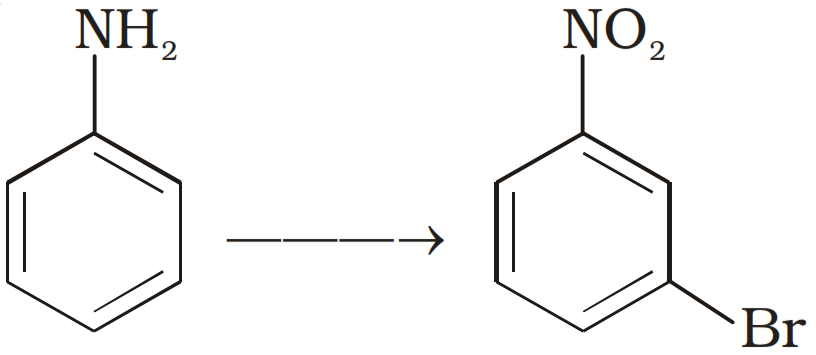
How will you carry out the following conversion?
How can you determine the rate law of the following reaction?
$2\text{NO}(\text{g})+\text{O}_2(\text{g})\xrightarrow{\ \ \ \ \ }2\text{NO}_2(\text{g})$
What is meant by elevation in boiling point? Why is it a colligative property?
Arrange the following compound in increasing order of their reactivity in nucleophilic addition reaction.
Ethanal, Propanal, Propanone, Butanone.
Write structures of different dihalogen derivatives of propane.
Complete the following equations :
(i) $CH _3- CH _2- Cl \xrightarrow{+ A } B \xrightarrow{ C } CH _3- CH _2- NH _2+ HCOOH$
(ii) $CH _3- I \xrightarrow{+ A } B \xrightarrow{ C } CH _3- NH - CH _3$
Nitrogen pentoxide decomposes according to equation: $\text{2N}_{2}\text{O}_{5}\text{(g)}\rightarrow\text{4NO}_{2}\text{(g)}+\text{O}_{2}\text{(g)}.$
This first order reactionwas allowed to proceed at $40^\circ C$ and the data below were collected:
$[N_2O_5](M)$ Time $(min)$
$0.400$ $0.00$
$0.289$ $20.0$
$0.209$ $40.0$
$0.151$ $60.0$
$0.109$ $80.0$
  1. Calculate the rate constant. Include units with your answer.
  2. What will be the concentration of $N_2O_5 $ after $100$ minutes?
  3. Calculate the initial rate of reaction.