Question
Discuss induced emf produced in a conducting rod during its motion in direction perpendicular to uniform magnetic field with reference to Lorentz force and obtain its expression.

Answer

Force acting on free electron is $\overrightarrow{ F }=-e(\vec{v} \times \overrightarrow{ B })$. Due to this force, free electron tend to meet at end Q and same amount of positive charge gets exposed at end $P$. Potential difference arising between P and Q has value $B vl$. Thus, it acts like a battery having emf $\varepsilon= Bvl$.

Need a full question paper?

Generate a complete, print-ready paper with questions like this in minutes — across 16+ boards, with answer keys.
Start Generating Free

Similar questions

A uranium$-238$ nucleus, initially at rest, emits an alpha particle with a speed of $1.4 \times 10^7m/s.$ Calculate the recoil speed of the residual nucleus thorium$-234.$ Assume that the mass of a nucleus is proportional to the mass number.
The amplitude of the magnetic field part of a harmonic electromagnetic wave in vacuum is $B _0$$=510 nT$. What is the amplitude of the electric field part of the wave?
Two resistances are connected in parralel in the ratio of 3: 4. Compare the results of the heat generated in them.
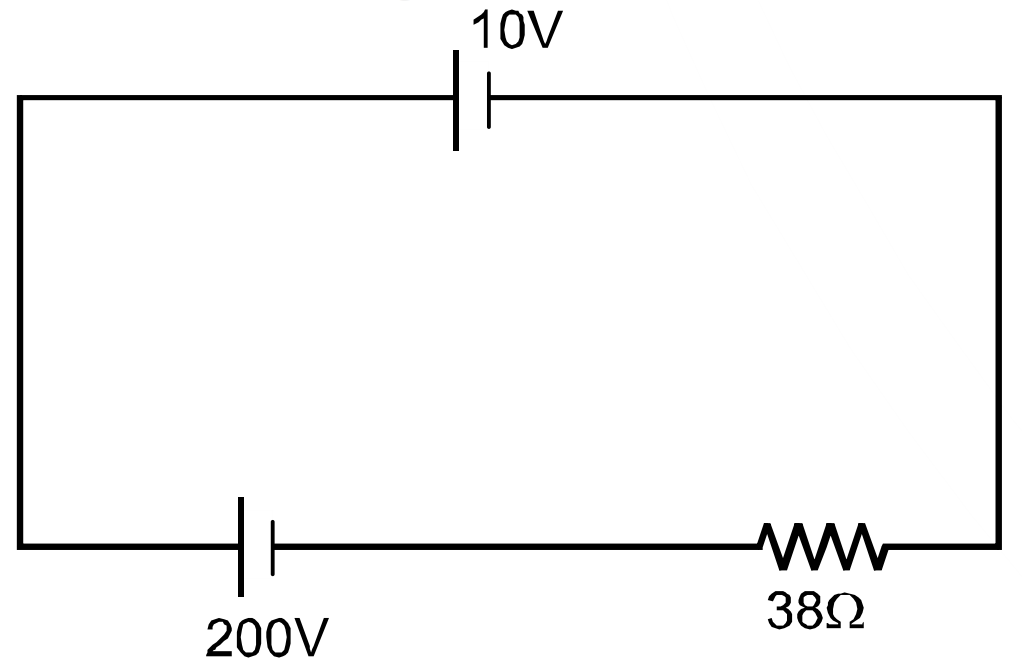
A 10V cell of negligible internal resistance is connected in parallel across a battery of emf 200V and internal resistance $38\Omega$ as shown in the figure. Find the value of current in the circuit.
A circular wire-loop of radius a carries a total charge Q distributed uniformly over its length. A small length dL of the wire is cut off. Find the electric field at the centre due to the remaining wire.
An e.m. wave is travelling in a medium with a velocity v = $v \hat{i}$. The electric field oscillations, of this e.m. wave, are along the $y$-axis.
a. Identify the direction in which the magnetic field oscillations are taking place, of the e.m. wave.
b. How are the magnitudes of the electric field and magnetic fields in the electromagnetic wave related to each other?
Electrons are emitted from the surface when green light is incident on it, but no electrons are ejected when yellow light is incident on it. Do you expect electrons to be ejected when surface is exposed to (i) Red light and (ii) Blue light?
Write magnitude and direction of force acting on poles of bar magnet placed in a magnetic field.
Consider a 10cm long portion of a straight wire carrying a current of 10A placed in a magnetic field of 0.1T making an angle of 53° with the wire. What magnetic force does the wire experience?
The equation of refraction at a spherical surface is $\frac{\mu_2}{\text{v}}-\frac{\mu_1}{\text{u}}-=\frac{\mu_2-\mu_1}{\text{R}}.$ Taking $\text{R}=\infty,$ show that this equation leads to the equation $\frac{\text{Real depth}}{\text{Apparent depth}}=\frac{\mu_2}{\mu_1}$ for refraction at a plane surface.