Question
Discuss structure of the carbonyl group.

Answer

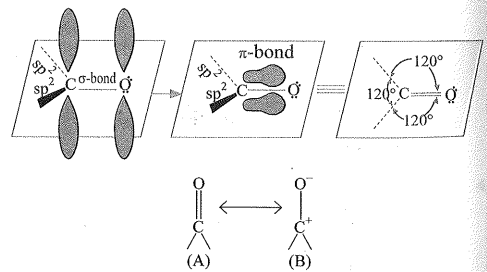
$\rightarrow$ The carbonyl carbon atom is $sp^2-$ hybridised and forms three sigma $(\sigma )$ bonds.
$\rightarrow$ The fourth valence electron of carbon remains in its p-orbital and forms a $\pi -$bond with oxygen by overlap with $p-$orbital of an oxygen.
$\rightarrow$ In addition, the oxygen atom also has two non bonding electron pairs. Thus, the carbonyl carbon and the three atoms attached to it lie in the same plane and the $\pi -$electron cloud is above and below this plane.
$\rightarrow$ The bond angles are approximately $120^\circ$ as expected of a trigonal coplanar structure $($Fig$).$
Image
$\rightarrow$ The carbon$-$oxygen double bond is polarised due to higher electronegativity of oxygen relative to carbon. Hence, the carbonyl carbon is an electrophilic $($Lewis acid$),$ and carbonyl oxygen, a nucleophilic $($Lewis base$)$ centre. Carbonyl compounds have significant dipole moments and are polar than ethers. The high polarity of the carbonyl group is explained on the basis of resonance involving neutral $(A)$ and a dipolar $(B)$ structures as shown.

Need a full question paper?

Generate a complete, print-ready paper with questions like this in minutes — across 16+ boards, with answer keys.
Start Generating Free

Similar questions

Write chemical reactions to show that open structure of D-glucose contains the following:
  1. Straight chain.
  2. Five alcohol groups.
  3. Aldehyde as carbonyl group.
Arrange the following in increasing order of their basic strength.
(ii) $\left.C _6 H _5 NH _2, C _6 H _5 N_{\left( CH _3\right.}\right)_2,\left( C _2 H _5\right)_2 NH$

(ii) Aniline, p -nitro aniline, p -toluidine
(iii) $C _6 H _5 NH _2, \quad C _6 H _5 NHCH _3, \quad C _6 H _5 CH _2 NH _2$
Note on: Cyclic structure of glucose.
The density of copper metal is $8.95\ g\ cm^{–3}.$ If the radius of copper atom be $127.8$ pm, is the copper unit cell simple cubic, body-centred cubic or face-centred cubic$?\ ($Given: Atomic mass of $Cu = 63.54\ g\ mol^{–1}$ and $N_A = 6.02 \times 10^{23}\ mol^{–1}).$
An organic compound ' $A$ ' having molecular formula $\mathrm{C}_3 \mathrm{H}_6$ on treatment with aqueous $\mathrm{H}_2 \mathrm{SO} 4$ gives ' $B$ ' which on treatment with $\mathrm{HCl} / \mathrm{ZnCl}_2$ gives ' C '. The compound C on treatment with ethanolic KOH gives back the compound ' A '. Identify the compounds A, B, C.
A special thermometer (Beckmann thermometer) is used to determine molecular weight by freezing point depression method instead of ordinary thermometer. Why?
Give reasons:
  1. $PCl_5$ is more covalent than $PCl_3.$
  2. $O-O$ bond has lower bond dissociation enthalpy than S-S bond.
  3. $F_2$ is a stronger oxidising agent than $Cl_{2}.$
In $PCl_5,$ phosphorus is in $sp^3d$ hybridised state but all its five bonds are not equivalent. Justify your answer with reason.
Give reasons for the following:
  1. Transition metals form alloys.
  2. $Mn_2O_3$ is basic whereas $Mn_2O_7$ is acidic.
  3. $Eu^{2+}$ is a strong reducing agent.
Explain Equilibrium constant for Daniell by nernst equation and calculate it's value