Question
Discuss the classification of monohydric alcohols containing $\ce{C_{sp}^3-OH}$ bond.

Answer

$\rightarrow \ce{C_{sp}^3} - OH$ bond: In this class of alcohols. the $-OH$ group is attached to an $sp^3$ hybridised $3$ carbon atom of an alkyl group. They are further classified as follows:
$\rightarrow$ Primary, secondary and tertiary alcohols: In these three types of alcohols, the $-OH$ group is attached to primary, secondary and tertiary carbon atom, respectively as depicted below :
Image
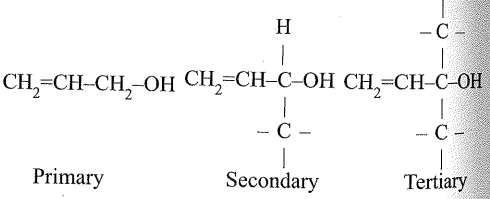
$\rightarrow$ Allylic alcohols : In these alcohols, the $-OH$ group is attached to an $sp^3$ hybridised carbon next the carbon$-$carbon double bond, that is to an allylic carbon. For example,​​​​​​​
Image
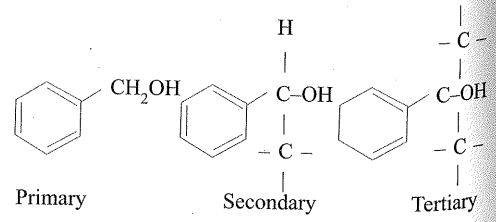
$\rightarrow$ Benzylic alcohols : In these alcohols, the $-OH$ group is attached to an $sp^3 - $ hybridised carbon atom next to an aromatic ring. For example,​​​​​​​
Image
$\rightarrow$ Allylic and benzylic alcohols may be primary, secondary or tertiary.

Need a full question paper?

Generate a complete, print-ready paper with questions like this in minutes — across 16+ boards, with answer keys.

Start Generating Free

Similar questions

What happens when D-glucose is treated with the following reagents?
(i) HI, (ii) Bromine water.
Indicate the steps in the preparation of: $\ce{KMnO_4}$ from pyrolusite ore.
A solution of $\ce{KMnO_4}$ on reduction yields either a colourless solution or a brown precipitate or a green solution depending on $pH$ of the solution. What different stages of the reduction do these represent and how are they carried out?
Give the mechanism for the formation of ethanol from ethene.
$i.$ Determine the units of rate constant for first and zero order reaction.
$ii.$ Show that time required for the completion of $99\%$ of the first order reaction is twice the $90\%$ of completion of the reaction.
A compound ‘$X’ \ce{(C_2H_4O)}$ on oxidation gives ‘$Y’ \ce{(C_2H_4O_2)}. ‘X’$ undergoes haloform reaction. On treatment with $\ce{HCN} ‘X’$ forms a product ‘$Z’$ which on hydrolysis gives $2-$ hydroxy propanoic acid.
  1. Write down structures of ‘$X’ $ and ‘$Y$’.
  2. Name the product when ‘$X’$ reacts with dil. $\ce{NaOH}$.
  3. Write down the equations for the reactions involved.
  1. Deficiency of which vitamin causes night $-$ blindness?
  2. Name the base that is found in nucleotide of $\text{RNA}$ only.
  3. Glucose on reaction with $\ce{HI}$ gives $n\ -$ hexane. What does it suggest about the structure of glucose?
Differentiate between retention and inversion.
Write the isomers of the compound having formula $C _4 H _9 Br$.
Differentiate between rate of reaction and reaction rate constant.