Question
Discuss the continuity of the function $\text{f(x)}=\begin{cases}2\text{x}-1,&\text{if }\text{ x}<2\\\frac{3\text{x}}{2},&\text{if }\text{ x}\geq2\end{cases}$

Answer

When x < 2, we have
f(x) = 2x - 1
We know that a polynomial function is everywhere continuous.
So, f(x) is continuous for each x < 2
When x > 2, we have
$\text{f(x)}=\frac{3\text{x}}{2}$
The functions 3x and 2 are continuous being the polynomial and constant function, respectively.
Thus, the quotient function $\frac{3\text{x}}{2}$ is continuous at each x > 2
Now,
Let us consider the point x = 2
$\text{f(x)}=\begin{cases}2\text{x}-1,&\text{if }\text{ x}<2\\\frac{3\text{x}}{2},&\text{if }\text{ x}\geq2\end{cases}$
We have
$(\text{LHL at x}= 2)=\lim\limits_{\text{x}\rightarrow2^-}\text{f(x)}=\lim\limits_{\text{h}\rightarrow0}\text{f}(2-\text{h})\\=\lim\limits_{\text{h}\rightarrow0}(2(2-\text{h})-1)=4-1=3$
$(\text{LHL at x}= 2)=\lim\limits_{\text{x}\rightarrow2^+}\text{f(x)}=\lim\limits_{\text{h}\rightarrow0}\text{f}(2+\text{h})\\=\lim\limits_{\text{h}\rightarrow0}\frac{3(\text{h}+2)}{2}=3$
Also,
$\text{f}(2)=\frac{3(2)}{2}=3$
$\therefore\ \lim\limits_{\text{x}\rightarrow2^-}\text{f(x)}=\lim\limits_{\text{x}\rightarrow2^+}\text{f(x)}=\text{f}(2)$
Thus, f(x) is continuous at x = 2
Hence, f(x) is everywhere continuous.

Need a full question paper?

Generate a complete, print-ready paper with questions like this in minutes — across 16+ boards, with answer keys.
Start Generating Free

Similar questions

A die is thrown 5 times. Find the probability that an odd number will come up exactly three times.
A die is thrown 6 times. If ‘getting an odd number’ is a success, what is the probability of
  1. 5 successes?
  2. at least 5 successes?
  3. at most 5 successes?
A pair of dice is thrown 4 times. If getting a doublet is considered a success, find the probability distribution of number of successes.
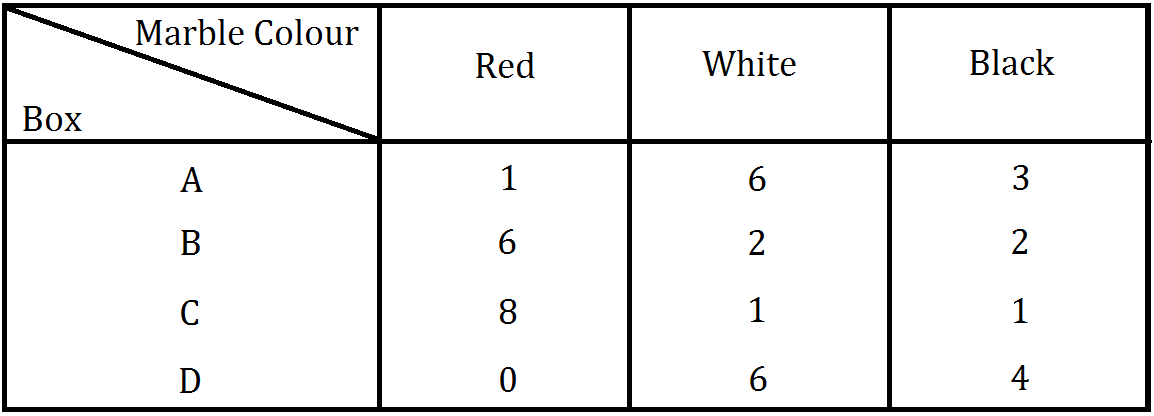
Suppose we have four boxes A, B, C, D containing coloured marbles as given below:

One of the boxes has been selected at random and a single marble is drawn from it. If the marble is red, what is the probability that it was drawn from,

  1. Box A?
  2. Box B?
  3. Box C?
Find a point on the curve y = x3 + 1 where the tangent is parallel to the chord joining (1, 2) and (3, 28).
Solve the following equation:
$\text{x}\frac{\text{dy}}{\text{dx}}+\text{y}=\text{y}^2$
Solve the following systems of linear equations by cramer's rule:
x + y = 1,
x + z = -6,
x - y - 2z = 3
Using elementary row transformations, find the inverse of the matrix $\text{A}=\begin{bmatrix}1 & 2&3 \\2 & 5&7\\-2&-4&-5 \end{bmatrix}.$
Suppose a girl throws a die. If she gets 1 or 2, she tosses a coin three times and notes the number of tails. If she gets 3, 4, 5 or 6, she tosses a coin once and notes whether a ‘head’ or ‘tail’ is obtained. If she obtained exactly one ‘tail’, what is the probability that she threw 3, 4, 5 or 6 with the die?
Differentiatet $\tan^{-1}\Big(\frac{x}{\sqrt{1-x^2}}\Big)$ with respect to $\sin^{-1}(2x\sqrt{1-x^2}).$