Question
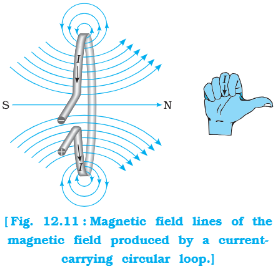
Discuss the magnetic field due to a current-carrying circular loop.###State the characteristics of the magnetic field produced by a current-carrying circular loop. Sketch its magnetic field lines.
Answer

When a current is passed through a circular loop, a magnetic field is produced around it.
$\rightarrow$ The pattern formed by the magnetic field lines of the magnetic field due to a current-carrying circular loop is shown in figure 12.11.

Image
$\rightarrow$ The magnetic field lines of the field produced by a current-carrying circular loop are circular and concentric near the loop.
$\rightarrow$ As we move away from wire, the concentric circles representing the magnetic field around it become larger and larger.
(The magnetic field is proportional to the current and decreases as we move away from the loop.)
$\rightarrow$ When we reach at the centre of the circular loop, the arcs of these big circles would appear as a straight line.
$\rightarrow$ Here every point on the circular wire carrying current would give rise to the magnetic field appearing as straight lines at the centre of the loop.By applying the Right-hand thumb rule, it can be seen that every section of the wire produces magnetic field/field lines in the same direction within the loop.
$\rightarrow$ Hence, at the centre of the circular loop, all the magnetic field lines are in the same direction and aid each other due to which the strength of the magnetic field increases.
$\rightarrow$ In case of a current-carrying circular coil having $N$ turns, the magnetic field produced is ' $N$ ' times as large as that produced by a coil having single turn, assuming that all turns have nearly the same radius.This is because the current in each circular turn has the same direction and the field due to each turn then just adds up.
$\rightarrow$ Thus, magnitude of the magnetic field $B$ produced at the centre of the coil is:
(1) Directly proportional to the current $I$ flowing through it, i.e., $B \propto I$
(2) Inversly proportional to the radius $r$ of the coil, i.e., $B \propto \frac{1}{r}$
(3) Directly proportional to the total number of turns $N$ of the coil, i.e., $B \propto N$

Need a full question paper?

Generate a complete, print-ready paper with questions like this in minutes — across 16+ boards, with answer keys.

Start Generating Free

Similar questions

Distinguish between: Fossil fuels and Bio fuels
Explain sexual reproduction in flowering plants.###Explain all the events that occur for the development of seed from flower.
Explain the conduction of water through the Xylem.
Write short note on: Budding
Write brief explanation about heterotrophic nutrition.###Write a short note: Heterotrophic mode of nutrition
difference between:
Series combination of resistors and parallel combination of resistors
Explain the flow of energy in the ecosystem
You observed trait of earlobe whether they are free or attached in four different couples, along with their children.
(1) Couple has all the children with free ear- lobe even mother has attached earlobe. What do you think about father's earlobe?
(2) Couple has children with 1 : 1 ratio for free and attached earlobe. What do you think about their father-mother for this trait?
(3) In a couple, both father and mother have attached earlobe. What do you think about their children?
(4) A couple has four children, out of which three have free earlobe and one has attached earlobe. What do you think about their parents?
$(a)$ Name a metal which does not stick to glass?
$(b)$ Name a non-metal which is good conductor of electricity?
$(c)$ Name the metal which is commonly used in thermit welding?
$(d)$ What gets deposited at the cathode, a pure or impure metal?
Explain electrical energy and derive its formula. Obtain Joule's law of heating.###Derive the formula of the heat energy produced in the conductor because of electric current flows in it for the fixed time-interval ' $t$ '. Give its unit.