Question
Dispersion of light.

Answer

The process of separation of light into its component colours while passing through a medium is called dispersion of light. When white light passes through a glass prism, it spreads out into a band of different colours (components) called the spectrum of light. The colours in the spectrum of white light are violet, indigo, blue, green, yellow, orange and red.

Formation of a rainbow is an example of dispersion of light in nature. In this case, raindrops are responsible for dispersion of sunlight.

Dispersion takes place because the refractive index of a material such as glass or water, is different for different colours. It is maximum for violet colour and minimum for red colour. Hence, in the spectrum of white light (sunlight) obtained with a prism, violet light is deviated the most while red light is deviated the least. The deviation of light corresponding to other colours lies in between.

Need a full question paper?

Generate a complete, print-ready paper with questions like this in minutes — across 16+ boards, with answer keys.
Start Generating Free

Similar questions

An electric iron of 1100 W is operated for 2 hrs daily. What will be the electrical consumption expenses for that in the month of April? (The electric company charges Rs 5 per unit of energy).
Write short note: Pre-disaster management.
There are two important fuels A and B both of which are extracted from deep inside the earth. Fuel A is a thick, dark, foul smelling liquid whereas fuel B is a black solid. Combustion of both the fuels produces products, C, D, E and F. The product C makes the rainwater only slightly acidic but it is mainly responsible for causing global warming. The product D is neither acidic nor basic. It is harmless and does not affect the environment in any way. Both E and F attack breathing system of humans and are mainly responsible for causing acid rain. In addition to combustion of fuels A and B, the product F is also formed when lightning occurs in the sky.
  1. What are (i) fuel A, and (ii) fuel B?
  2. Name (i) C (ii) D (iii) E, and (iv) F?
  3. What is the process of formation of F during lightning known as?
  4. Which fuel is supposed to be exhausted sooner : A or B?
  5. Which fuel is mostly used for generating electricity at thermal power plants?
What is a mirage? With a neat labelled diagram, explain the conditions under which it is seen.
A filamentous alga X is found in ponds, lakes and slow-moving streams. The filament of this alga simply breaks into two (or more) pieces on maturing and each piece then grows to become a complete new alga.
  1. Name an alga which X is likely to be.
  2. What is the colour of X?
  3. What is the method of forming new algae by the breaking of parent alga known as?
  4. An Amoeba also breaks up to form two daughter Amoebae. What is the difference in the splitting of Amoeba and splitting of this alga as a method of reproduction?
  5. Name one marine animal which reproduces in the same way as alga X.
Draw a neat labelled diagram of Hope’s apparatus. Explain how this apparatus can be used to demonstrate anomalous behaviour of water. Draw a graph of temperature of water against time.
Distinguish between Direct current and alternating current.
Which precautions will you take during spraying of pesticides?
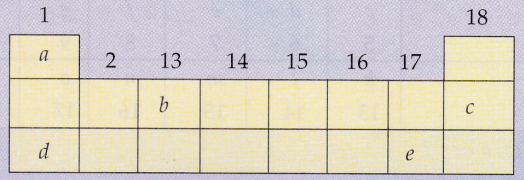
The following diagram shows a part of the periodic table containing first three periods in which five elements have been represented by the letters a, b, c, d and e (which are not their chemical symbols):
  1. Select the letter which represents an alkali metal.
  2. Select the letter which represents a noble gas.
  3. Select the letter which represents a halogen.
  4. What type of bond is formed between a and e?
  5. What type of bond is formed between d and e?
The speed of light in vacuum and in two different glasses is given in the table below:
Medium
Speed of light
Vacuum
Flint glass
Crown glass
$3.00 \times 10^8m/ s$
$1.86 \times 10^8m/ s$
$1.97 \times 10^8m/ s$
  1. Calculate the absolute refractive indexes of flint glass and crown glass.
  2. Calculate the relative refractive index for light going from crown glass to flint glass.