Question
Dispersive power depends upon

Answer

( b)$\omega$ depend only on nature of material.

Need a full question paper?

Generate a complete, print-ready paper with questions like this in minutes — across 16+ boards, with answer keys.

Start Generating Free

Similar questions

Two points $P$ and $Q$ are maintained at the potentials of $10\, V$ and $-4\,V$, respectively. The work done in moving $100$ electrons from $P$ and $Q$ is
Two identical cells each of emf $1.5 \,V$ are connected in parallel across a parallel combination voltmeter connected in the circuit measures $1.2 \,V$.

The internal resistance of each cell is.................$\Omega$
The displacement of a particle executing SHM is given by:
$y=5 \sin \left(4 t+\frac{\pi}{3}\right)$
If T is the time period and the mass of the particle is 2 g , the kinetic energy of the particle when $t=\frac{T}{4}$ is given by:
A $10\, V$ battery connected to $5\,\Omega $ resistance coil having inductance $10\, H$ through a switch drives a constant current in the circuit. The switch is suddenly opened and the time taken to open it is $2\, ms$. The average $emf$ induced across the coil is
Light of wavelength $4000 \,Å$ falls on a photosensitive metal and a negative $2V$ potential stops the emitted electrons. The work function of the material (in $eV$) is approximately$(h = 6.6 \times {10^{ - 34}}Js,\;\;e = 1.6 \times {10^{ - 19}}C,\;\;c = 3 \times {10^8}m{s^{ - 1}})$
A train starting from rest first accelerates uniformly up to a speed of $80 \mathrm{~km} / \mathrm{h}$ for time $t$, then it moves with a constant speed for time 3t. The average speed of the train for this duration of journey will be (in $\mathrm{km} / \mathrm{h}$ ) :
Even Carnot engine cannot give $100\%$ efficiency because we cannot
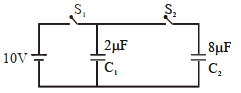
A $2\, \mu F$ capacitor $C _{1}$ is first charged to a potential difference of $10\, V$ using a battery.Then the battery is removed and the capacitor is connected to an uncharged capacitor $C _{2}$ of $8\, \mu F$. The charge in $C _{2}$ on equilibrium condition is $\ldots\,\mu C$. (Round off to the Nearest Integer)
Two identical magnetic dipoles of magnetic moments $1.0 \,A-m^2$ each, placed at a separation of $2\,m$  with their axis perpendicular to each other. The resultant magnetic field at a point midway between the dipoles is
What will be the minimum angle of incidence such that the total internal reflection takes place from both the surface?.......$^o$