MCQ
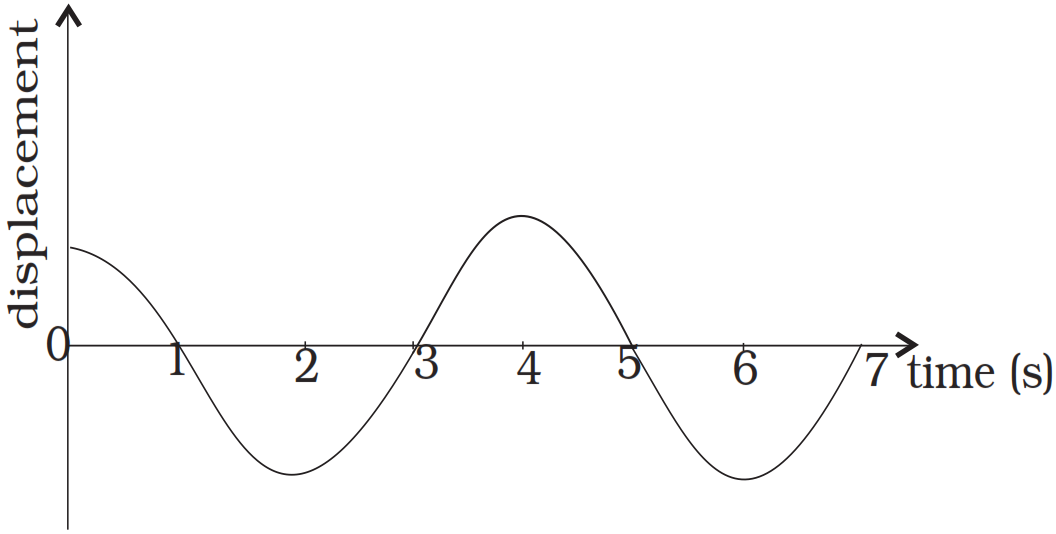
Displacement vs. time curve for a particle executing $\text{S.H.M.}$ is shown in Fig. Choose the correct statements:
  • A
    Phase of the oscillator is same at $t = 0 s$ and $t = 2 s.$
  • B
    Phase of the oscillator is same at $t = 2 s$ and $t = 6 s.$
  • C
    Phase of the oscillator is same at $t = 1 s$ and $t = 5 s.$
  • Both $B$ and $C$

Answer

Correct option: D.
Both $B$ and $C$
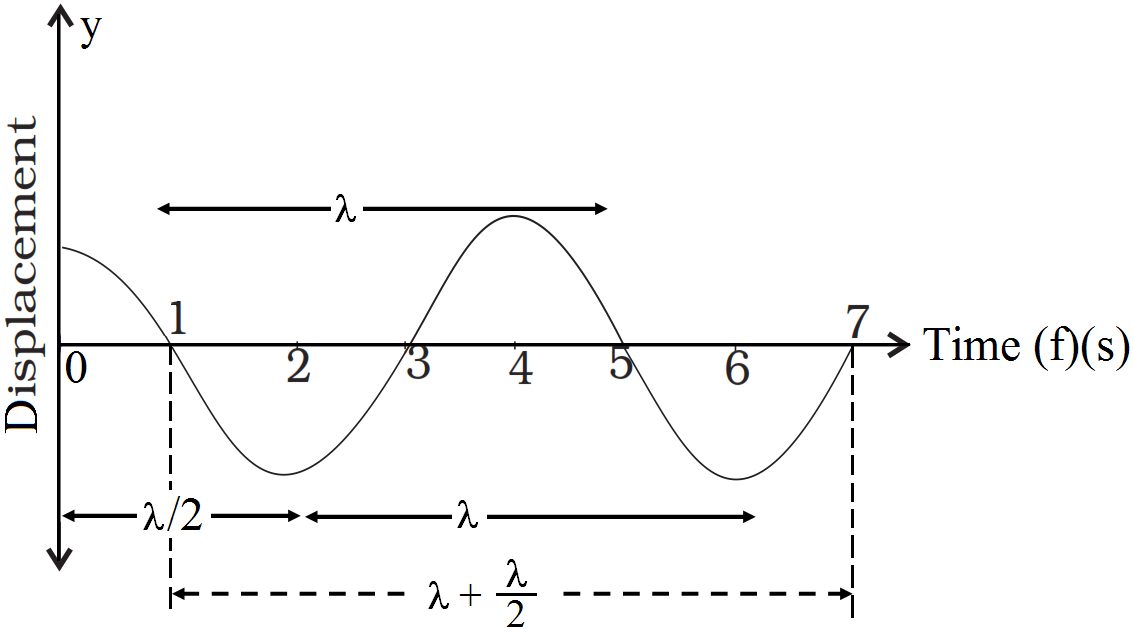
Two particles are said to be in same phases if the mode of vibration is same i.e, their distance will be $\text{n}\lambda(\text{n}=1,2,3...)$
Distance between particles at $t = 0$ and $t = 2$ is $\frac{\lambda}{2}.$
So, articles are not in same phase.

As from figure the particles at $t = 2 \sec$ are at distance $\lambda$,
so are in same phase.
Particles at $t = 1, t = 7$ are the distance $\lambda+\frac{\lambda}{2}=\frac{3\lambda}{2}$ so are not in phase.
Particles at $t = 1$ and $5\sec$ are at distance $= \lambda$ so are in same phase.

Need a full question paper?

Generate a complete, print-ready paper with questions like this in minutes — across 16+ boards, with answer keys.

Start Generating Free

Similar questions

A body is pulled along a rough horizontal surface with a velocity $6\,m/s$. If the body comes to rest after travelling $9\,m$ , then coefficient of sliding friction, is- (Take $g = 10\,m/s^2$ )
Two cars of masses $m_1$ and $m_2$ are moving in circles of radii $r_1$ and $r_2$, respectively. Their speeds are such that they make complete circles in the same time $t$. The ratio of their centripetal acceleration is
The gravitational potential energy of a body of mass $‘m’$ at the earth’s surface $ - mg{R_e}$. Its gravitational potential energy at a height ${R_e}$ from the earth’s surface will be (Here ${R_e}$ is the radius of the earth)
The volume $V$ of a given mass of monoatomic gas changes with temperature $T$ according to the relation $V = KT ^{2 / 3}$. The workdone when temperature changes by $90\, K$ will be $x\,R$. The value of $x$ is $[ R =$ universal gas constant $]$
A particle is projected with a speed ${v_0} = \sqrt {gR} $ . The coefficient of friction between the particle and the hemispherical plane is $\mu  = 0.5$ . Then, the initial acceleration of the particle is
A spring mass system (mass $m$, spring constant $\mathrm{k}$ and natural length $l$ ) rest in equilibrium on a horizontal disc. The free end of the spring is fixed at the centre of the disc. If the disc together with spring mass system, rotates about it's axis with an angular velocity $\omega,\left(\mathrm{k} > > \mathrm{m} \omega^{2}\right)$ the relative change in the length of the spring is best given by the option
The molar heat capacity of oxygen gas at STP is nearly 2.5R. As the temperature is increased, it gradually increases and approaches 3.5R. The most appropriate reason for this behaviour is that at high temperatures:
The bob of a simple pendulum is of mass $10\, gm$. It is suspended with a thread of $1\, m$. If we hold the bob so as to stretch the string horizontally and release it. What will be the tension at the lowest position   ......... $N$
An engine approaches a hill with a constant speed. When it is at a distance of $0.9\, km$, it blows a whistle whose echo is heard by the driver after $5\, seconds$. If the speed of sound in air is $330\, m/s$, then the speed of the engine is .... $m/s$
A steel ball is dropped in a viscous liquid. The distance of the steel ball from the top of the liquid is shown below. The terminal velocity of the ball is closest to .......... $m/s$