Question
Distinguish between compression and rarefaction.

Answer

A longitudinal wave propagates by means of compressions and rarefactions.
When a vibrating object moves forward, it pushes and compresses the air in front of it creating a region of high pressure. This region is called a compression (C), as shown in Fig. This compression starts to move away from the vibrating object. When the vibrating object moves backwards, it creates a region of low pressure called rarefaction (R), as shown in Fig.
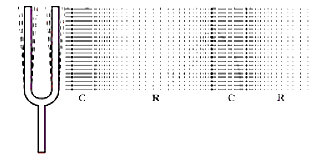

A vibrating object creating a series of compressions (C) and rarefactions (R) in the medium
Compressions are the regions of high density where the particles of the medium come very close to each other and rarefactions are the regions of low density where the particles of the medium move away from each other.
Need a full question paper?

Generate a complete, print-ready paper with questions like this in minutes — across 16+ boards, with answer keys.

Start Generating Free

Similar questions

The focal length of a lens is (i) positive, (ii) negative.
In each case, state the kind of lens.
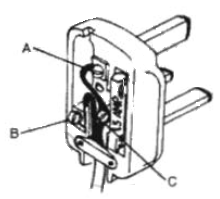
Fig. shows a 3 pin plug with the cover removed. The electric cable
connected to the plug contains 3 wires with colour coded insulation namely brown, blue and green.

Image

  1. Identify each of the colour coded wires by stating to which of the
    terminals A, B or C in the diagram they should be connected.
  2. Identify the terminal through which no current passes in normal
    circumstances.
  3. What is the purpose of the earthed wire connected to an electric
    appliance like an electric heater? Describe how it works.
A boy of mass $40 \ kg$ runs up a height of $30$ steps, each $20 \ cm$ high. Find:
(i) The force of gravity acting on the boy.
(ii) The work done by the boy against gravity. (Take $g = 9.8 ms^{−2})$
A converging lens forms the image of an object placed in front of it, beyond $2F_2$​​​​​​​ of the lens.
Draw a ray diagram to show the formation of image.
(a) Give at lesst two differences between chemical change and nuclear change.
(b) State three precautions in the handling of radionctive substances,
Two resistors of resistance 4 Ω and 6 Ω are connected in parallel to a cell to draw 0.5 A current from the cell.

Calculate current in each resistor.

The speed of light in air is $3 \times 10^8 ms^{-1}$. Calculate the speed of light in water. The refractive index of water is $4 / 3$.
(i) Draw a ray diagram to show how the lens can be used as a ‘magnifying glass’? State the nature of the lens.
(ii) In what respect does the image in (i) above different from the image formed by a concave lens?
The magnification by a lens is -3. Name the lens and state how are u and v related?
Define energy and state the unit of energy and the law of conservation of energy.