Question
Distinguish between convergent and divergent beams of light.

Answer

Difference between convergent and a divergent beam of light.
Convergent beam Divergent beam
1. Rays of light converge to a point as the beam progresses Rays of light diverge from each other as the beam progresses
2. The rays concentrate at a point The rays emerging from a point source
3. A parallel beam of light converges on passing through a convex lens A parallel beam of light diverges on passing through a concave lens

Need a full question paper?

Generate a complete, print-ready paper with questions like this in minutes — across 16+ boards, with answer keys.
Start Generating Free

Similar questions

Define
1. Scalar quantities.
2. Vector quantities. Give two differences between scalar and vector quantities.
A block of wood of mass 24 kg floats on water. The volume of wood is $0.032 m^3$. Find : (a) the volume of block below the surface of water,
(b) the density of wood.
(Density of water $=1000 kg m ^{-3}$ )
How will you find the volume of an irregular solid $($lighter than water$)$ by displacement method?
Draw a neat and labelled diagram of a vernier callipers. Name its main parts and state their functions.
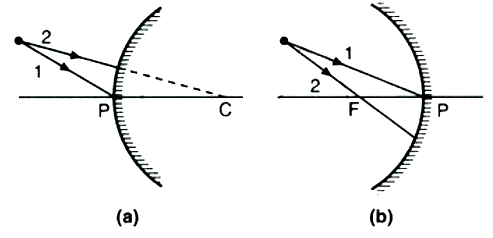
Complete the following diagrams in Figure by drawing the reflected rays for the incident rays 1 and 2.
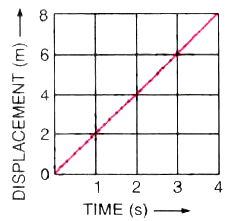
Figure (a) shows the displacement-time graph for the motion of a body. Use it to calculate the velocity of the body at t = 1 s, 2 s and 3 s, and then draw the velocity-time graph in Figure (b) for it.
(a) (b)
Explain how is the height of mercury column in tube of a simple barometer, a measure of the atmospheric pressure.
A cube of lead of side 8 cm and R.D. 10.6 is suspended from the hook of a spring balance. Find the reading of spring balance. The cube is now completely immersed in sugar solution of R.D. 1.4. Calculate the new reading of spring balance.
Prove that the loss in weight of a body when immersed wholly or partially in a liquid is equal to the buoyant force (or upthrust) and this loss is because of the difference in pressure exerted by liquid on the upper and lower surfaces of the submerged part of body.
What is meant by zero error of vernier callipers ? How is it determined? Draw neat diagrams to explain it. How is it taken in account to get the correct measurement?