Question
Distinguish between D.C. and A.C.

Answer

D. C.A. C.
Definition In DC, the current's direction doesn't change.In AC, the direction of the current keeps reversing periodically.
Load TypeDC’s load is generally resistive in nature.AC’s load is resistive, inductive or capacitive.
The direction of flowing electronsIn DC, the flowing electrons are unidirectionalThe direction of flow of electrons in AC is bidirectional.
FrequencyDC's frequency is Zero.AC's frequency is 50 or 60 Hz.
TransmissionWe can transmit it over a long distance with negligible losses.We can transmit it over a long distance with few losses.
PurposeUsed in electroplating, electrolysis, electronic equipment, and more.Used in factories, industries, households.
Passive ParameterResistanceImpedance

Need a full question paper?

Generate a complete, print-ready paper with questions like this in minutes — across 16+ boards, with answer keys.
Start Generating Free

Similar questions

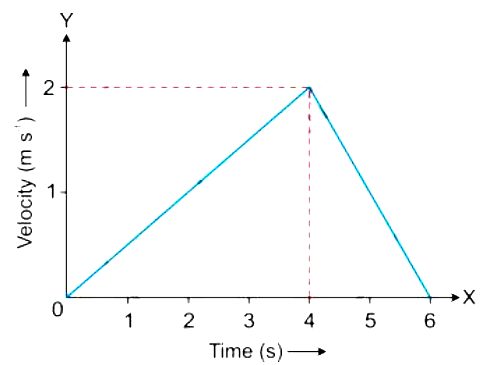
Figure shows the velocity-time graph of a particle moving in a straight line.

(i) State the nature of motion of particle.
(ii) Find the displacement of particle at $t =6 s$.
(iii) Does the particle change its direction of motion?
(iv) Compare the distance travelled by the particle from $0$ to $4 s$ and from $4 s$ to $6 s $.
(v) Find the acceleration from $0$ to $4 s$ and retardation from $4$ s to $6 s $.
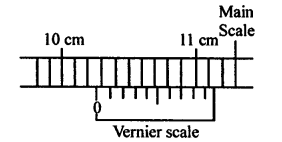
Figure shows the position of vernier scale, while measuring the external length of a wooden cylinder.
1.What is the length recorded by main scale?
Image
2.Which reading of vernier scale coincides with main scale?
3.Calculate the length.
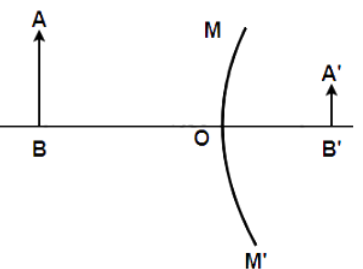
AB is the object, $A_1B_1$ is its image. MM' is the position of the mirror. Complete the ray diagram and find the position of the center of curvature and focus of the mirror. Also, measure the focal length.
Image
Define the terms :
1.wavelength
2.amplitude
3.frequency.
Describe various methods of magnetising a piece of iron.
State and explain the law of action and reaction. by giving two examples.
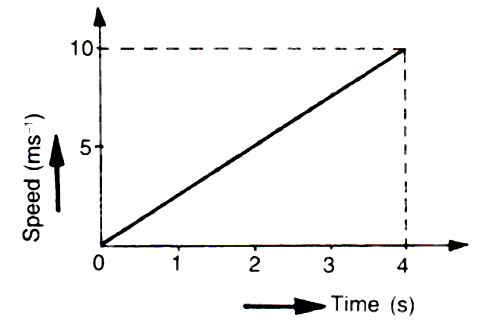
The speed-time graph of a body having a mass of $100 g$ moving along a straight line path is shown here. Find the force acting on the body.
Draw velocity - time graphs for the following situations:
1. When a body, is moving with uniform velocity.
2. When a body is moving with variable velocity, but uniform acceleration.
3. When a body is moving with variable velocity, but uniform retardation.
4. When a body is moving with variable velocity and variable acceleration.
How does the time period (T) of a simple pendulum depend on its length (l)? Draw a graph showing the variation of $T^2$ with l. How will you use this graph to determine the value of g (acceleration due to gravity)?
Define : magnetic field, magnetic meridian, geographical meridian, declination and magnetic equator.