Question
Distinguish between electrolytic and galvanic cells.

Answer

Electrolytic cell:

  1. This device is used to bring about a non-spontaneous chemical reaction by passing an electric current.
  2. It is used to bring about a chemical reaction generally for the dissociation (electrolysis) of compounds.
  3. In this cell, electrical energy is converted into chemical energy.
  4. In this cell, the cathode is negative and the anode is positive.
  5. Electrolytic cells are irreversible.
  6. Oxidation takes place at the positive electrode and reduction at the negative electrode.
  7. The electrons are supplied by the external source and enter through cathode and come out through anode.
  8. It is used for electroplating, electrorefining, etc.

Electrochemical cell (Galvanic cell or Voltaic cell):

  1. This device is used to produce electrical energy by a spontaneous chemical reaction.
  2. It is used to generate electricity.
  3. In this cell, chemical energy is converted into electrical energy.
  4. In this cell, the cathode is positive and the anode is negative.
  5. Electrochernical cells are reversible.
  6. Oxidation takes place at the negative electrode and reduction at the positive electrode.
  7. The electrons move from anode to cathode in the external circuit.
  8. It is used as a source of electric current.

Need a full question paper?

Generate a complete, print-ready paper with questions like this in minutes — across 16+ boards, with answer keys.
Start Generating Free

Similar questions

How are xenon fluorides $XeF_2, XeF_4$ and $XeF_6$ obtained ? Give suitable reactions.
Explain extrinsic semiconductor and doping.
What are the applications of a buffer solution ?
Answer the following
Define the following term: Nanotechnology
Write the electrode reactions when lead storage cell generates electricity. What are the anode and cathode and the electrode reactions during its recharging?
Calculate the standard enthalpy of combustion of $CH _2 COOH _{(1)}$ from the following data : $\begin{aligned}\Delta_{ f } H ^0\left( CO _2\right)=-393.3 kJ mol ^{-1} \\\end{aligned}$
$\begin{aligned}

& \Delta_{ f } H ^0\left( H _2 O \right)=-285.8 kJ mol ^{-1} \\
& \Delta_{ f } H ^0\left( CH _3 COOH \right)=-483.2 kJ mol ^{-1}
\end{aligned}$
When gold crystallizes, it forms face-centred cubic cell. The unit cell edge length is 408 pm .
Calculate the density of gold. [Molar mass of gold $=197 g \ mole ^{-1}$ ]
Which flower is an example of self cleaning?
Write the monomer used for preparation of PVC.
An ether $(A), C_5H_{12}O,$ when heated with excess of hot $HI$ produce two alkyl halides which on hydrolysis form compound $(B)$ and $(C),$ oxidation of $(B)$ gave and acid $(D),$ whereas oxidation of $(C)$ gave a ketone $(E).$ Deduce the structural formula of $(A), (B), (C), (D)$ and $(E).$
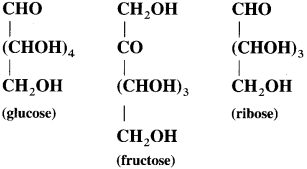
Observe the following structural formulae carefully and answer the questions.

Image

(1) How many OH groups are present in glucose, fructose and ribose respectively?
(2) Which other functional groups are present in these three compounds?

How are the following compounds prepared using Grignard reagent
(1) Ethanol
(2) Propan-I-ol
(3) Propan-2-ol
(4) 2-Methyl propan-2-ol?|