Question
Distinguish between embryo and endosperm found in Angiosperms.

Answer

Differences between Embryo and Endosperm :
S.No.EmbryoEndosperm
1It is the product of syngamy.It is the product of triple fusion.
2It is formed fertilized egg.It develops from primary endosperm nucleus.
3It gives birth to new plants.It only provides nutrition to developing embryo.
4It develops and differentiate to produce plumule, cotyledons, radicles.It does not produce any such structure.
5Embryo lies within seed.Endosperm exists only in endospermic seeds. In nonendospermic seeds, it is consumed completely by developing embryo.
 

Need a full question paper?

Generate a complete, print-ready paper with questions like this in minutes — across 16+ boards, with answer keys.
Start Generating Free

Similar questions

F1 progeny of pea plant bearing violet flowers and snapdragon plant bearing red flowers were selfed to produce their respective F2 progeny. Compare the phenotypes, the genotypes and the pattern of inheritance of their respective F2 progeny.
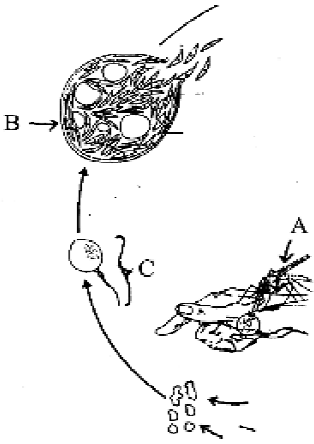
Study a part of the life cycle of malarial parasite given below. Answer the questions that follow:

  1. Mention the roles of ‘A’ in the life cycle of the malarial parasite.
  2. Name the event ‘C and the organ where this event occurs.
  3. Identify the organ ‘B’ and name the cells being released from it.
Two children, A and B aged 4 and 5 years respectively visited a hospital with a similar genetic disorder. The girl A was provided enzyme-replacement therapy and was advised to revisit periodically for further treatment. The girl, B was, however, given a therapy that did not require revisit for further treatment.
  1. Name the ailments the two girls were suffering from?
  2. Why did the treatment provided to girl A required repeated visits?
  3. How was the girl B cured permanently?
Write any four benefits of using GM plants.
A recombinant DNA molecule was created by ligating a gene to a plasmid vector. By mistake, an exonuclease was added to the tube containing the recombinant DNA. How does this affect the next step in the experiment i.e. bacterial transformation?
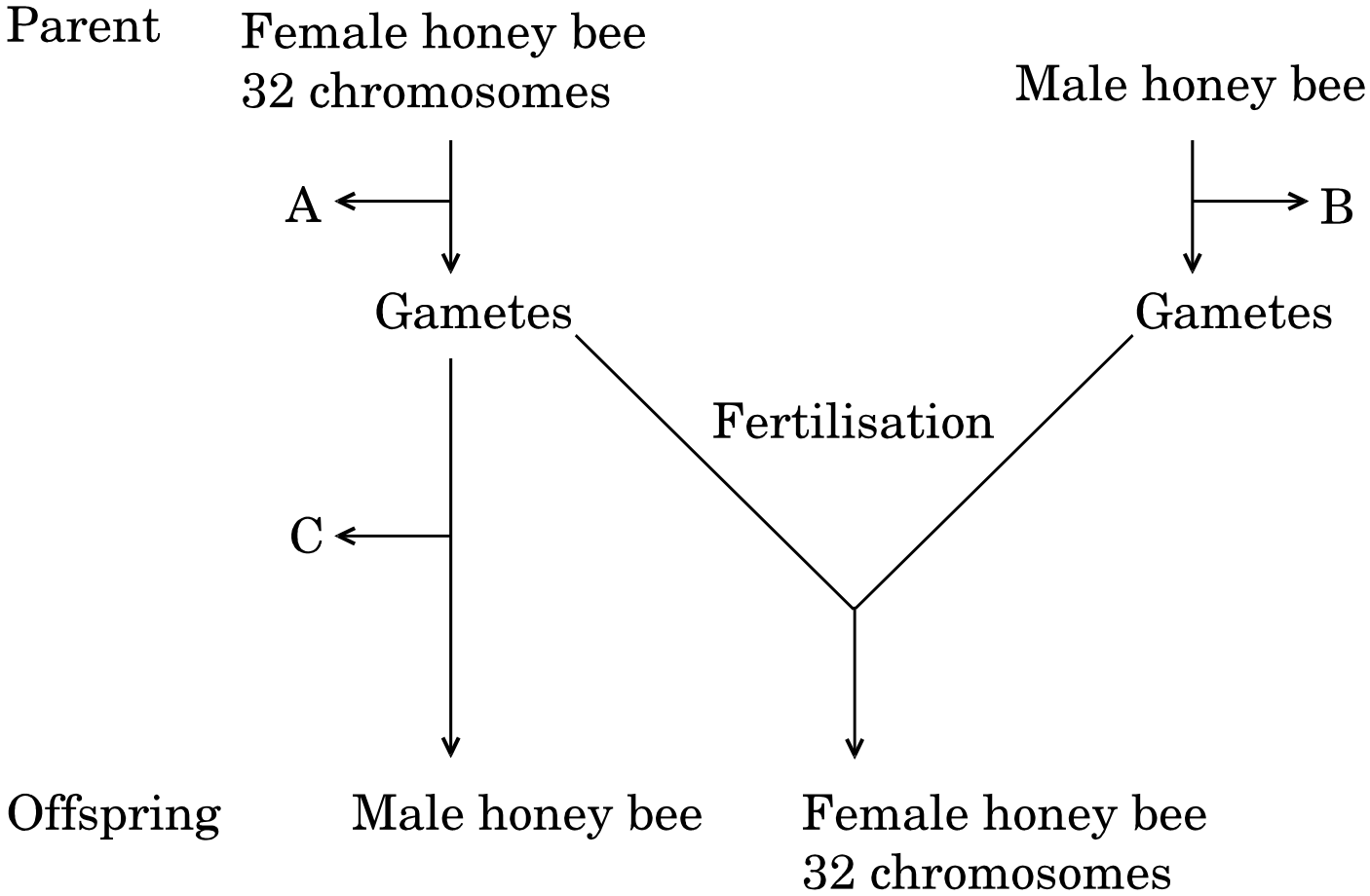
The cytological observations made in a number of insects led to the development of the concept of genetic/ chromosomal basis of sex-determination mechanism. Honey bee is an interesting example to study the mechanism of sex-determination. Study the schematic cross between the male and the female honey bees given below and answer the questions that follow:

  1. Identify the cell divisions ‘A’ and ‘B’ that lead to gamete formation in female and male honey bees respectively.
  2. Name the process ‘C’ that leads to the development of male honey bee (drone).
Answer the following questions:
Write the characteristic features of anther, pollen and stigma of wind pollinated flowers.
Describe the decomposition cycle in a terrestrial ecosystem and make its diagrammtic representation.
What is the significance of the slope of regression in a species-area relationship?
Explain logistic growth with equation.